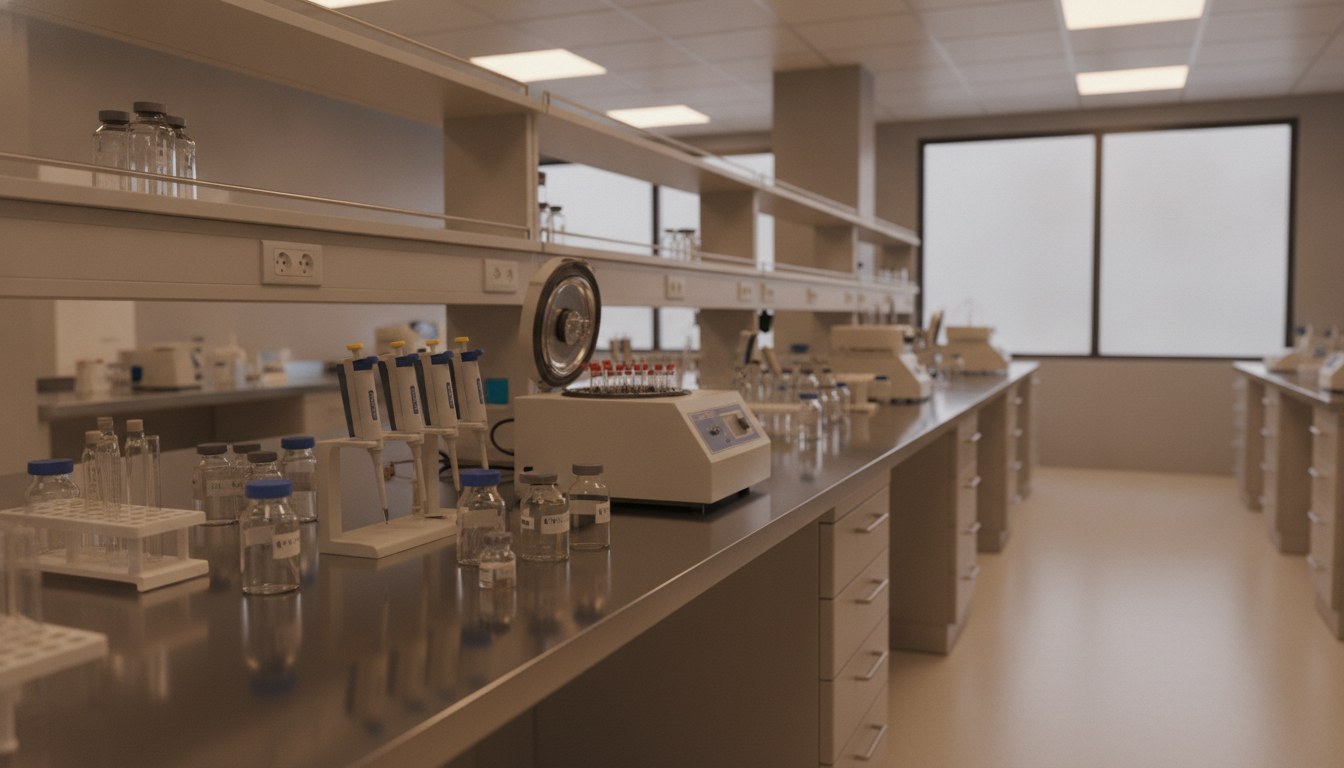
Anthropic's life sciences team sat down with Endpoints News for an unusually candid Q&A, discussing enzyme research, the company's physical biology laboratory, and the early shape of a preclinical pipeline. The conversation gives one of the clearest public pictures yet of how the AI company is positioning itself inside the drug discovery process rather than simply selling tools to pharmaceutical partners.
What the Team Revealed
The Endpoints interview covered three distinct threads: enzyme engineering work driven by Claude, the operations and purpose of Anthropic's wet lab, and what the team described as a preclinical pipeline still in early stages. Enzyme research is a natural fit for AI-assisted biology because protein function prediction and directed evolution are computationally intensive tasks where large language models have shown real utility. The team indicated that Claude is being used to reason over experimental data and help prioritize which enzyme variants to synthesize and test. Anthropic Builds Wet Lab to Test AI Biology Claims, and that physical infrastructure is central to validating predictions before any candidate moves toward a clinical setting.
Key Facts
- Anthropic's life sciences team is running active enzyme research using Claude as a reasoning layer over experimental data.
- The company's biology wet lab exists to test and validate AI-generated predictions in physical experiments.
- A preclinical pipeline is described as early-stage, with no clinical candidates announced publicly yet.
- The Q&A was published by Endpoints News, a publication focused on drug development and biotech.
- Anthropic is framing its biology work as internal research, not purely a software licensing play.
The decision to build and operate a wet lab was not obvious for a company whose core product is a large language model. Most AI companies in the life sciences space act as software vendors, licensing models or APIs to established pharma and biotech firms. Anthropic Opens Biology Lab to Accelerate AI Drug Program, signaling that the company sees hands-on experimentation as necessary to close the loop between prediction and reality. That loop matters because a model that generates plausible-sounding biology without experimental grounding has limited value for actual drug development.
The lab lets us ask whether what Claude predicts actually holds up when you run the experiment. That feedback is how you build trust in the system over time.Anthropic Life Sciences Team, via Endpoints News

Where the Preclinical Pipeline Stands
The team was measured about pipeline expectations. No clinical candidates were named, and the framing was explicitly early-stage. Still, the existence of a preclinical program at all marks a shift. Anthropic's AI Biology Lab Reports Its First Major Find earlier this year, and the Endpoints Q&A suggests that find was not a one-off demonstration but part of a broader, ongoing effort. The life sciences team appears to be operating with some autonomy inside Anthropic, running experiments and building out domain expertise rather than simply advising on how external customers might use the API.
The implications for the broader AI-in-drug-discovery field are worth watching. If Anthropic moves from lab findings to actual drug candidates, it would enter territory currently occupied by companies like Recursion, Insilico Medicine, and Isomorphic Labs. Each of those companies has years of domain-specific infrastructure and biotech partnerships. Anthropic's advantage, if it has one, is the general reasoning capability of Claude applied to biology problems without the constraints of a narrow, task-specific model. How that plays out in preclinical attrition rates remains to be seen. Those following the latest Claude AI news will want to monitor whether Anthropic publishes peer-reviewed results as the pipeline matures.
For now, the Endpoints Q&A is the most detailed public account of what the life sciences team is actually doing day to day. The combination of enzyme research, a working wet lab, and a stated preclinical program suggests Anthropic is treating biology as a serious research vertical rather than a marketing story about AI's potential. The next meaningful milestone will likely be a published result or a named collaboration with a clinical-stage partner.


