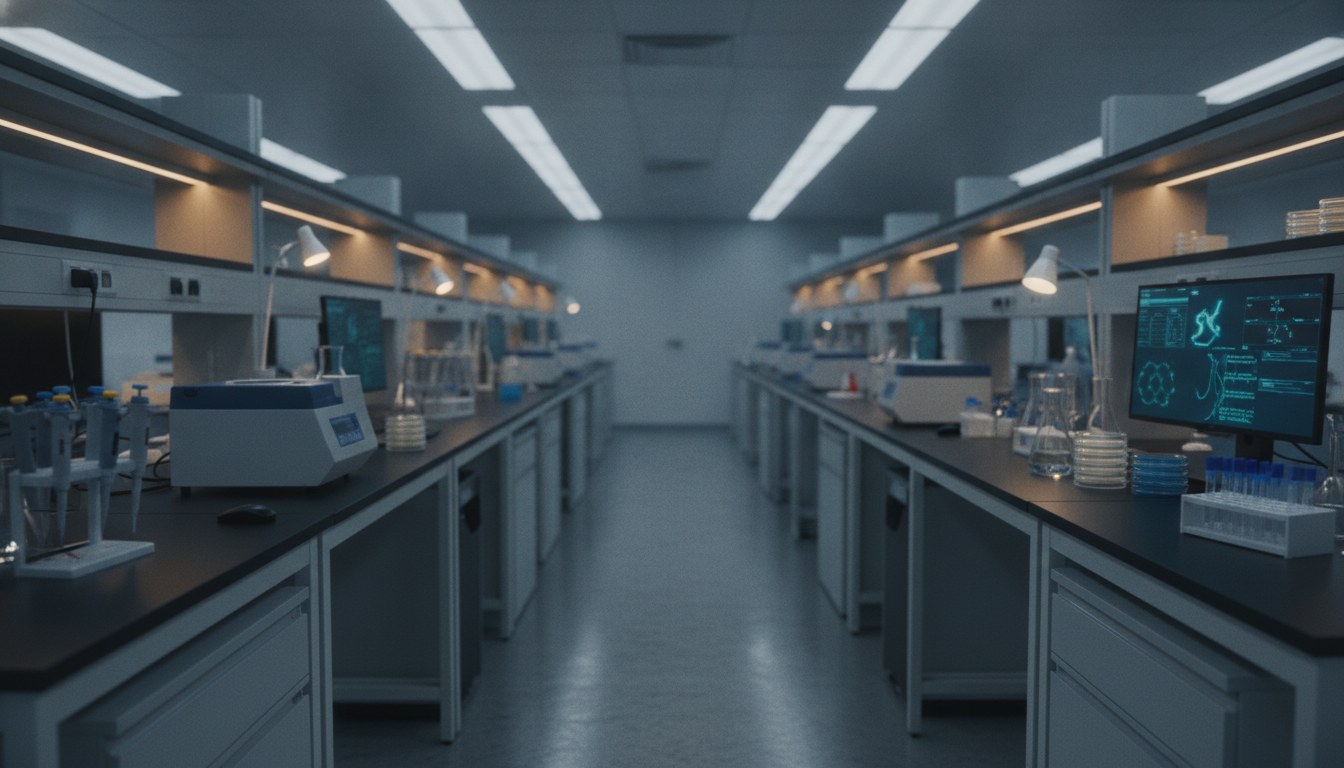
Anthropic, the company behind the Claude family of AI models, has established a physical wet laboratory dedicated to biology research. The move takes the San Francisco-based AI firm into hands-on experimental science, a domain traditionally far removed from software development. It reflects a growing belief inside the company that validating AI-generated biological insights requires real bench work, not just computational analysis.
Why a Wet Lab Now
The decision to build out physical lab infrastructure follows months of expanding investment in the life sciences. Anthropic opened a biology lab earlier this year to accelerate its AI drug discovery program, and the new wet lab appears to be a direct extension of that initiative. Where the earlier effort focused on computational pipelines and AI-assisted drug candidate screening, a wet lab adds the capacity to run live experiments, culture cells, and handle biological samples. That capability closes a critical loop: AI models can suggest hypotheses, and researchers can now test them in-house rather than relying entirely on outside partners.
Key Facts
- Anthropic has set up a wet lab facility specifically for biology research
- The lab supports hands-on experimental work to validate AI-generated findings
- The initiative builds on the company's earlier AI drug discovery program
- Anthropic joins a small group of AI companies investing directly in physical lab infrastructure
- The move comes as AI systems are increasingly applied to complex biological problems
The timing is notable. AI models have advanced rapidly in their ability to reason about biology. Anthropic CEO Dario Amodei and OpenAI's Sam Altman have both told Congress that current AI systems can match or exceed PhD-level biological reasoning, which raises both the promise and the risk profile of the technology. Having a controlled, internal lab gives Anthropic a way to study what its models can actually accomplish in a physical science setting.
AI systems are becoming genuinely useful scientific collaborators, and that means we need the infrastructure to test what they produce in the real world.Anthropic spokesperson, via 80 Level

Broader Context for AI in Science
Anthropic has been building out its scientific ambitions on several fronts. The company has outlined a broad vision for how Claude can assist researchers, and it has launched grant programs to support rare disease research using AI tools. The wet lab fits into that pattern: rather than simply providing a model that answers biology questions, Anthropic wants to participate more directly in the research process itself.
There are practical reasons for this approach beyond scientific credibility. Anthropic has previously disclosed that foreign adversaries attempted to use Claude for weapons-related research, including in the biological domain. Running an internal lab gives the company better insight into what its models can and cannot do in applied biology contexts, which informs both safety guidelines and capability limits. Understanding the gap between what an AI suggests and what actually works in a lab is essential for setting responsible boundaries around biological use cases.
For the AI industry broadly, this kind of investment signals a shift. Companies that started as pure software operations are increasingly acquiring the physical and scientific infrastructure needed to participate in fields like drug discovery, materials science, and genomics. Anthropic's wet lab may be modest in scale compared to major pharmaceutical research centers, but its existence inside an AI company is itself significant. It puts experimental biology within the same organization that trains and deploys the models making biological predictions, creating a tighter feedback loop than any external collaboration could offer.
Details about the lab's size, staffing, and specific research agenda remain limited. Anthropic has not published a formal announcement, and the scope of what the facility will tackle is still unclear. What is clear is that the company is treating biology as a long-term priority, one that warrants sustained physical investment rather than occasional partnerships. As Anthropic continues to expand its scientific footprint, the wet lab represents one of the more concrete steps it has taken toward making that commitment tangible.


