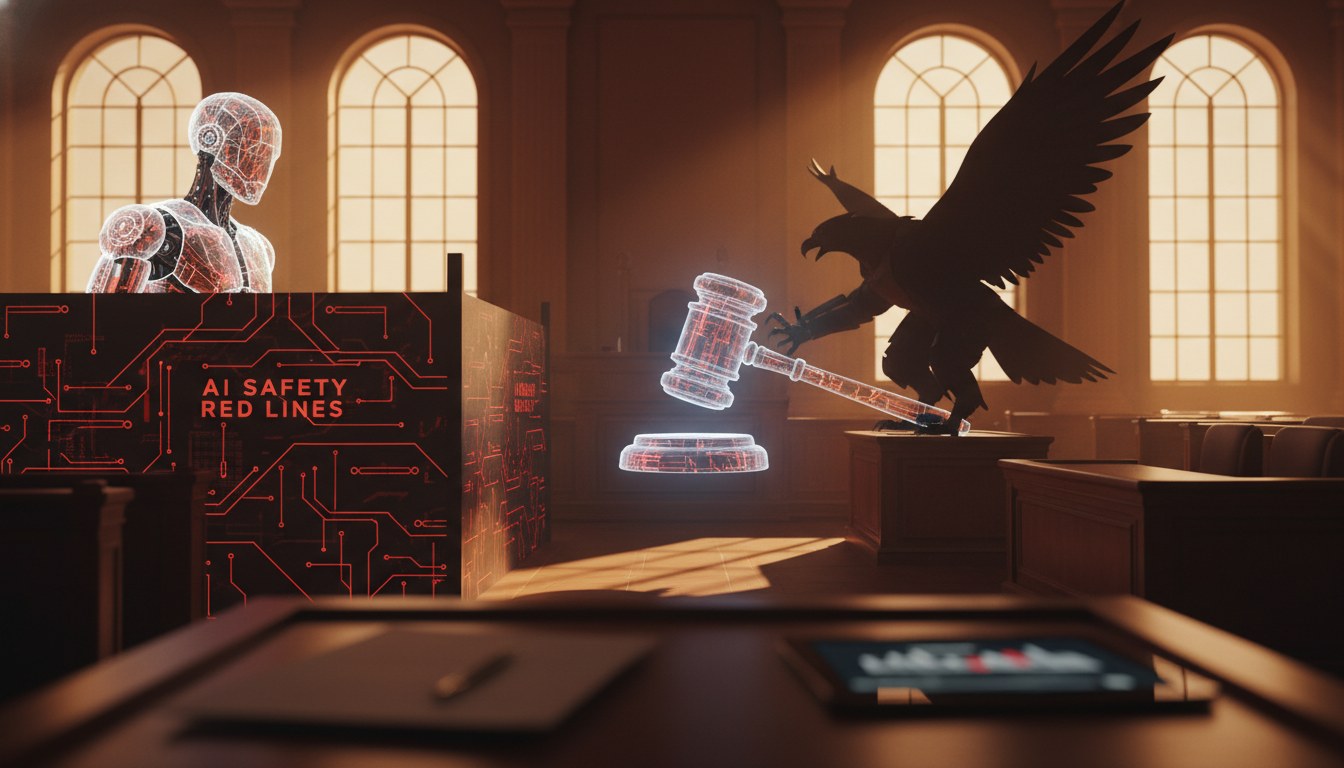
Anthropic published a formal statement this week responding to public remarks by Defense Secretary Pete Hegseth, who called the company's conduct "a master class in arrogance and betrayal" after months of negotiations over military AI access broke down. The dispute centers on two specific exceptions Anthropic requested when discussing terms of access to Claude: permission to exclude use of the model for mass domestic surveillance of Americans, and for fully autonomous lethal weapons systems.
Hegseth announced that the Department of Defense would designate Anthropic a supply chain risk under federal contracting law, implying the designation would bar defense contractors from using Claude on Pentagon business. Anthropic's statement pushes back on both the characterization and the legal scope of that action, while maintaining that it entered negotiations in good faith and supports all lawful military uses of its model.
The Two Exceptions at the Center of the Dispute
Anthropic says it went into discussions with the Pentagon prepared to support a wide range of national security applications, including intelligence analysis, logistics, cyber defense, and other sensitive work. The two uses it declined to enable are narrow in definition but carry significant implications.
Mass domestic surveillance of Americans runs into limits that Anthropic describes as non-negotiable. The company did not elaborate on the technical or legal reasoning in its public statement, but the position aligns with longstanding civil liberties principles around AI-assisted surveillance that Anthropic has articulated in other contexts. The second exception, fully autonomous weapons, reflects a technical judgment as much as an ethical one. Anthropic's statement notes directly that the company does not believe frontier AI models are reliable enough to be used in weapons systems that select and engage targets without human authorization. That position is not unusual among AI safety researchers, but it puts Anthropic at odds with the Pentagon's current direction on autonomous weapons acquisition.
Hegseth's characterization of those two exceptions as "arrogance and betrayal" drew a measured but pointed response. Anthropic's statement says the company tried in good faith to reach agreement and that supporting all lawful uses of AI for national security was always its intent. Declining to enable two specific unlawful or technically unreliable use cases, it argues, does not constitute a failure to deal.
Key Facts: Anthropic vs. Pentagon
- Exceptions Anthropic refused2: mass surveillance, autonomous weapons
- Designation statute10 USC 3252
- Designation scopeDoD contract work only
- Commercial & individual users affectedNone
- Anthropic's characterizationGood-faith negotiations
- Pentagon's characterization"Arrogance and betrayal"

The Statutory Limits of a Supply Chain Designation
Anthropic's statement spends considerable space on what the supply chain risk designation under 10 USC 3252 can and cannot actually do. The company's reading is that Hegseth's public framing overstated his statutory authority in ways that matter for how the designation's practical effects should be understood.
Under 10 USC 3252, a supply chain risk designation can restrict a defense contractor from using a specified technology on specific Department of Defense contracts. It cannot, Anthropic argues, affect how that contractor uses the same technology on civilian or commercial work unrelated to DoD business. And it has no direct bearing on how individual users, non-defense businesses, or other federal agencies access Claude independently. The overwhelming majority of Anthropic's revenue comes from commercial enterprise and individual customers with no DoD relationship, so if Anthropic's reading of the statute is correct, the designation's financial impact on the company would be limited.
"The designation would only affect Department of War contractors' use of Claude on Department of War contract work. Other uses would be completely unaffected, including contractors' use of Claude to serve their other customers." Anthropic, formal statement on Secretary Hegseth's comments, June 2026
Timing: A Pentagon Fight in the Middle of an IPO
The public exchange lands in an already consequential week for Anthropic. The company filed confidentially for an IPO on June 1, at a valuation of approximately $965 billion, setting up a public market debut that would rank among the largest technology listings in history. Pentagon-related risk disclosures will be a required element of the S-1 registration statement, which means underwriters and institutional investors are now reading Hegseth's statements alongside Anthropic's formal response.
The company's argument that the designation affects only a narrow slice of DoD contract work will be tested by the due diligence scrutiny that accompanies a public offering of this scale. Whether the legal framing holds up to investor examination, and whether it holds up to any court challenge if the Pentagon pursues a broader interpretation, are questions the IPO process will force into sharper focus.
Anthropic has consistently maintained that it supports Dario Amodei's position on AI and national security: that American AI leadership is a genuine strategic priority, and that the company wants to work with the government across most of the harder problems in that space. What it is not willing to do, the statement makes plain, is provide capability enabling mass surveillance of American citizens or removing human control from lethal targeting decisions. Those positions, Anthropic argues, are not negotiating failures. They are its terms. Whether the Pentagon accepts that framing, or escalates further, will shape one of the more consequential AI policy disputes of 2026. More background on Anthropic's public interest positions is available in our profile of the company.