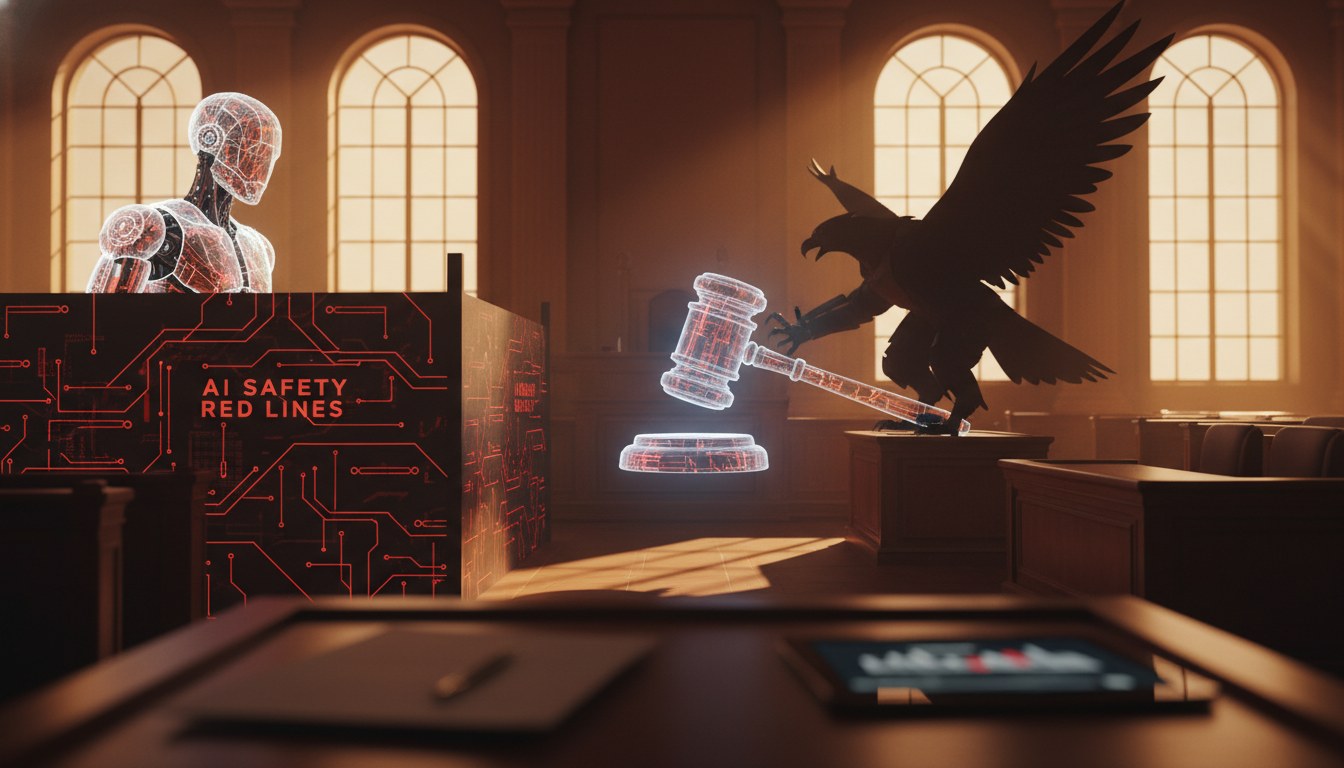
Starting in February 2026, the United States Department of Defense did something without modern precedent: it labeled Anthropic, a California AI company with no connection to any foreign government, a "supply chain risk" to national security. The reason was not espionage or export-control violations. It was a contract dispute over whether Claude could be used in fully autonomous weapons systems and domestic mass surveillance programs. Anthropic had said no. Defense Secretary Pete Hegseth and the Trump administration decided that refusal was disqualifying.
The designation set off a legal fight that has now moved through two federal courts, produced a scathing 43-page ruling from a California judge, and left Anthropic in an uncomfortable position: barred from new Defense Department work while its lawsuit grinds through the system, but free to serve other federal agencies and commercial customers in the meantime.
The Two Lines Anthropic Would Not Cross
Since its founding in 2021, Anthropic has included two explicit restrictions in every enterprise contract it signs: Claude cannot be deployed as the autonomous decision-making layer in lethal weapons without human oversight, and it cannot be used for mass domestic surveillance. These were not conditions invented to frustrate the Pentagon. They predated any government conversations and apply equally to every commercial customer.
When the DOD sought access to Claude for broader military applications, it asked Anthropic to remove or renegotiate those guardrails. Anthropic's lawyers say the company was unequivocal: it was "unwilling to allow two use cases, given its assessment of what today's technology can safely and reliably do." Hegseth, responding in February, formally invoked the Defense Federal Acquisition Regulation Supplement to designate Anthropic a supply chain risk effective immediately. The label had previously been reserved for companies linked to foreign adversaries, including Chinese telecommunications firms named under the FCC's Covered List.
Key Facts: Pentagon vs. Anthropic
- DOD designation issuedFebruary 2026
- Anthropic lawsuit filedMarch 9, 2026
- Judge Rita Lin preliminary injunctionMarch 26, 2026
- Injunction opinion length43 pages
- DC Appeals Court reversalApril 8, 2026
- Current DOD contract statusExcluded; other agencies unaffected

A Federal Judge Calls It Orwellian
Anthropic filed suit on March 9 in the Northern District of California, arguing the supply chain risk label violated its First and Fifth Amendment rights. The government's legal theory, as Anthropic's attorneys framed it in court, was that an American company could be designated a national security threat purely because it disagreed with federal policy on how its own product should be used.
US District Judge Rita Lin did not take long to weigh in. In a preliminary injunction issued on March 26, she blocked the Pentagon from enforcing the designation while the case proceeds. The ruling was pointed in its language. Lin found that the DOD had applied the supply chain risk statute in a way it was never written to allow, and she was candid about what the government's position implied.
"Nothing in the governing statute supports the Orwellian notion that an American company may be branded a potential adversary and saboteur of the U.S. for expressing disagreement with the government." US District Judge Rita Lin, Northern District of California, March 26, 2026
The ruling drew attention well beyond the AI industry. Legal observers noted that Lin's framing, if it holds on appeal, would significantly constrain the government's ability to use procurement sanctions as leverage against companies that decline specific use cases on policy grounds.
The Appeals Court Cuts the Other Way
Anthropic's California victory proved short-lived in the appellate system. On April 8, a three-judge panel of the DC Circuit Court of Appeals denied a separate motion from Anthropic to temporarily block the Pentagon's blacklisting while the main case plays out. The split decisions from the two federal courts left the company in an unusual position: the California injunction protects it in that district, but the DC ruling means the DOD designation formally remains in force at the federal level, blocking new defense contracts.
For Anthropic, the practical consequence is separation from a government market segment that competing AI companies are now actively cultivating. Reporting from May 7 indicated the Pentagon had quietly begun expanding its roster of AI defense suppliers to fill the gap, a development that compounds the commercial cost of the legal standoff.
The Congressional Research Service published a policy brief in April examining the dispute as a matter requiring legislative attention. The brief noted that the use of defense supply chain rules against a domestic AI company over a contractual use-case disagreement was without direct precedent, and suggested that Congress may need to clarify the statute's intended scope.
What Comes Next
The main lawsuit in California is expected to proceed through discovery and briefing over the coming months, with the core question being whether the DOD's application of supply chain risk rules to an AI company for refusing specific use cases is lawful. Anthropic's position is that its refusal is a policy stance protected by the First Amendment, not a security threat. The government's position is that federal procurement decisions do not require that level of justification.
The case has implications beyond Anthropic. Every AI lab that works with the government writes contracts that include some version of acceptable use restrictions. Whether those restrictions can expose a company to procurement sanctions, based solely on which use cases the lab declines, is now an open legal question that the industry is watching closely.
Anthropic has maintained that its constraints on Claude are consistent with its broader approach to AI governance and its publicly stated Responsible Scaling Policy, which commits the company to evaluating frontier models against specific risk categories before deployment. For a company that has built its reputation on safety-first AI, the argument that safety commitments can be treated as a national security liability is not one it appears willing to concede without a full court fight.
In the meantime, Anthropic's commercial momentum in the broader enterprise market has continued independent of the DOD dispute. The company's subscription and API business has grown substantially in 2026, suggesting that the Pentagon exclusion, painful as it is, represents one revenue channel rather than an existential threat to the business.