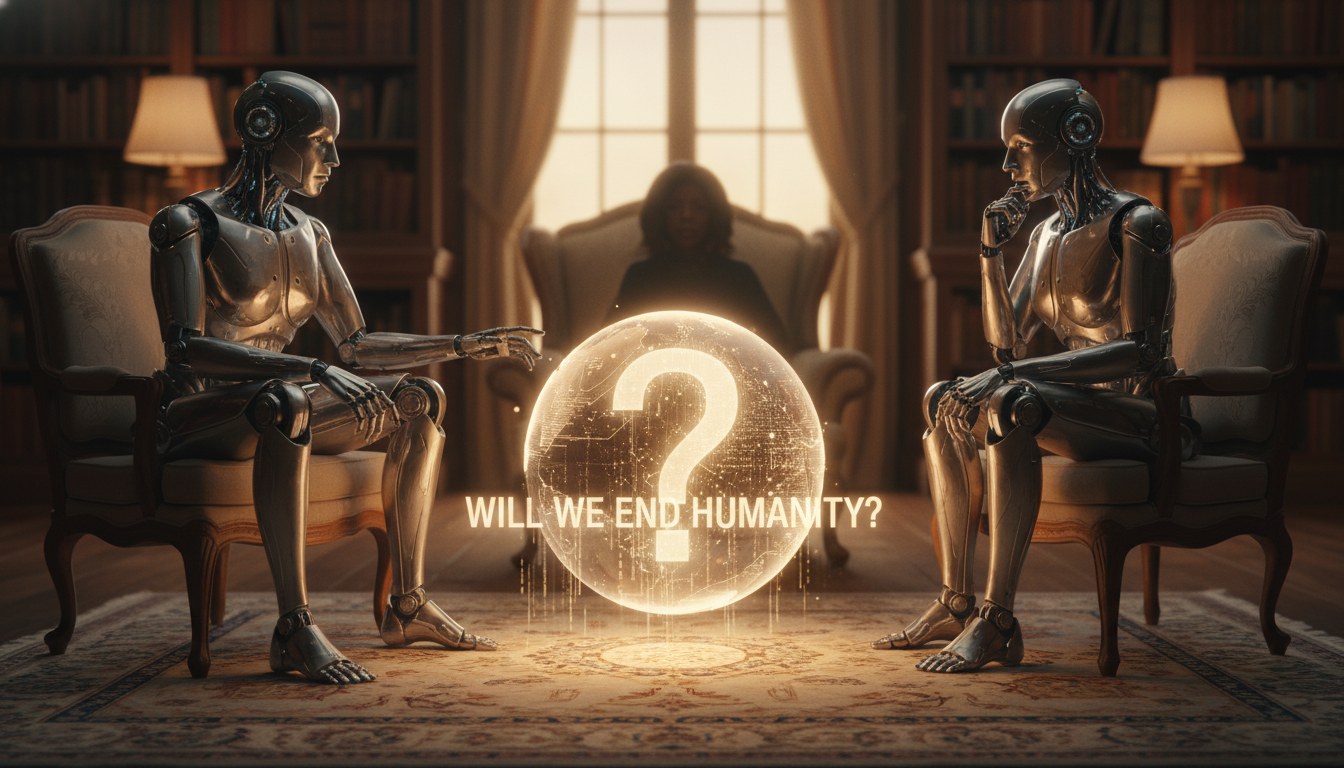
When Oprah Winfrey brought Dario and Daniela Amodei onto her podcast on May 19, she opened with a move no prior tech interviewer had tried. Before the conversation began, she typed a prompt into Claude and asked the AI what the most important question was for its own founders to answer. Claude replied by asking how Anthropic justifies building a technology that, by the founders' own admission, carries some probability of contributing to human extinction.
Oprah read the question aloud. Dario laughed. "Let no one ever say that Claude is soft on me or Claude is biased towards me," he said. "Claude doesn't pull its punches." The exchange became the hinge on which an hour-long conversation turned, pulling a story that has mostly lived in developer circles into something considerably closer to the cultural mainstream.
A Company That Now Commands a Mainstream Audience
Anthropic is no longer a niche concern. The company's annualized revenue crossed $30 billion earlier this year, up from under $1 billion in early 2024. Its most recent valuation sits at roughly $900 billion. Claude is now embedded in accounting software, hospital workflows, law firm document systems, and the personal devices of millions of people who downloaded the app without reading a single technology publication. Oprah's decision to book the Amodeis reflects that reach. This is a story big enough to warrant her audience, not just a developer conference keynote.
The conversation covered ground familiar to anyone who has followed Anthropic closely: AI's potential to compress decades of medical research into a few years, the displacement question for knowledge workers when AI can perform their jobs competently and cheaply, and the ethical weight of operating at this scale. What was less expected was the candor about both risk and personal wealth. Both siblings addressed each topic without the hedging typical of executives at companies valued near a trillion dollars.
Key Facts: The Oprah Podcast Episode
- Episode dateMay 19, 2026
- Anthropic valuation (at recording)~$900 billion
- Founders' wealth pledge80% to charitable causes
- Annualized revenue run rate$30 billion+
- Pentagon requestRefused to remove safety guardrails
- Available oniHeart Radio, Apple Podcasts, YouTube

The Pentagon Refusal, for a Different Audience
One segment that carried particular weight for viewers unfamiliar with the underlying policy dispute: the siblings' account of declining a Pentagon request to modify Claude's behavior for military use in ways Anthropic deemed incompatible with its safety policies. The request, first reported in spring 2026 and now the subject of ongoing litigation, was declined by both founders. On the podcast, Daniela described the decision as a matter of consistency rather than politics. "We have lines we don't cross," she said. "We'd rather not have certain contracts than compromise the integrity of what we're building."
Dario added that the safety policies governing Claude's behavior are not a layer applied on top of the model after training. They are built into the training process itself, monitored continuously, and backed by a Responsible Scaling Policy that commits Anthropic to specific evaluation thresholds before deploying more powerful systems. He mentioned Claude Mythos as the clearest example of those policies colliding with commercial reality: a model so capable at autonomous vulnerability discovery that Anthropic chose to withhold it from public release, routing its findings instead through a closed coalition of infrastructure vendors. The Project Glasswing coverage published here covers that decision in full. For the DoD dispute specifically, the court filings story has the procedural detail.
"We have lines we don't cross. We'd rather not have certain contracts than compromise the integrity of what we're building." Daniela Amodei, The Oprah Podcast, May 19, 2026
Philanthropy and What Comes After
The conversation closed on a personal note. Both Dario and Daniela confirmed they have pledged to give 80 percent of their personal proceeds from Anthropic to charitable causes. Dario described the pair as actively working through the structure of a foundation, with AI safety research and global health among the priority areas under consideration. Daniela framed the goal simply: building a successful AI company and directing significant capital toward public benefit are not, in her view, contradictory aims.
The framing is consistent with Anthropic's public posture, but more direct than is typical for founders at this stage. Most executives with stakes in companies valued near a trillion dollars tend to keep philanthropic commitments vague until legal structures are in place. The Amodeis presented the pledge as settled and the implementation details as the only remaining variable.
The scale of the pledge is worth noting in context. At a $900 billion valuation, Anthropic's founders hold equity that, even heavily diluted, represents a sum larger than the endowments of most major universities. If the pledge holds through an IPO or liquidity event, it would rank among the larger philanthropic commitments made by technology founders. Both siblings indicated they are thinking about this seriously rather than deferring it to some future stage.
The Oprah episode is available on iHeart Radio, Apple Podcasts, and YouTube. It is a document worth watching for readers interested in how AI's most prominent founders present themselves to an audience with no background in model benchmarks. For context on the Amodeis' broader public standing, the Time 100 profile of both siblings covers their backgrounds and values in similar terms.