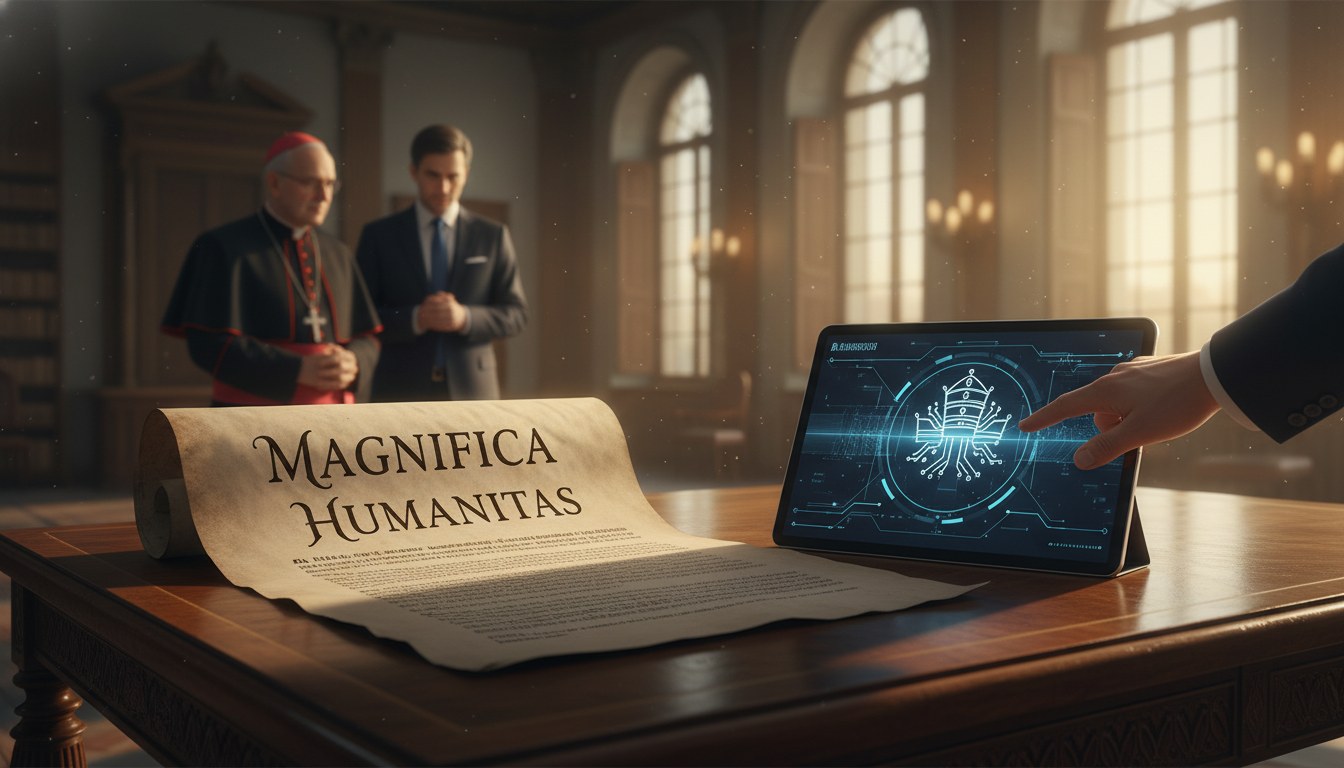
On May 15, 2026, Pope Leo XIV signed "Magnifica Humanitas," the Catholic Church's first formal encyclical on artificial intelligence. It will be released publicly on May 25 at the Vatican, and for that presentation Leo chose an unusual co-presenter: Christopher Olah, a co-founder of Anthropic whose research on neural network interpretability has shaped how the AI safety field thinks about what language models actually compute. The pairing places a frontier AI safety researcher at the center of one of the oldest institutions in the world as it tries to work out what it thinks about AI.
The Document and Its Date
The timing of the encyclical's signing carries deliberate symbolism. May 15 is the same calendar date, 135 years earlier, that Pope Leo XIII signed "Rerum Novarum," the 1891 letter on labor and capital that anchored Catholic social teaching through the industrial era. By choosing the same date, Leo XIV is signaling that "Magnifica Humanitas" is intended to occupy an analogous place in the Church's engagement with technological change.
The encyclical's central concern, according to Vatican officials and pre-release coverage, is "the protection of the human person in the age of artificial intelligence." That framing positions it not as a broad rejection of AI development but as an attempt to articulate the conditions under which AI is consistent with human dignity. Days before the signing, Leo XIV also announced a formal Vatican AI Commission, adding a standing institutional body to the one-time document.
Magnifica Humanitas at a Glance
- Document titleMagnifica Humanitas (Magnificent Humanity)
- SignedMay 15, 2026 (135 years after Rerum Novarum)
- Public releaseMay 25, 2026, Vatican
- Anthropic co-presenterChristopher Olah, co-founder
- Other presentersCardinal Fernández, Cardinal Czerny, Prof. Anna Rowlands, Prof. Léocadie Lushombo
- Vatican AI CommissionAnnounced days prior to encyclical release

Why Christopher Olah
Olah is one of Anthropic's seven co-founders and the researcher most associated with the company's work on mechanistic interpretability, the discipline of tracing exactly what calculations happen inside a language model at the level of individual circuits and features. His published papers on how neural networks internally represent concepts like emotions, spatial relations, and time are among the most cited in the AI safety literature, and his team at Anthropic has produced some of the clearest empirical results available on the question of whether AI systems can be understood from the inside.
His inclusion at a papal launch event is striking because it is not a diplomatic gesture. Olah does not lead Anthropic's policy team. His work sits at the scientific core of one of the hardest questions in AI safety: can we understand what these systems are doing well enough to know whether they are safe? That is the kind of question "Magnifica Humanitas" appears to be asking from a different direction.
"If we cannot understand what happens inside a neural network, we cannot be confident it will behave as intended. Interpretability is how we close that gap." Christopher Olah, Anthropic research overview, 2025
An Institution Building a Durable Position
The Vatican AI Commission and the encyclical together sketch an institutional strategy rather than a one-off response. The document provides a theological and ethical framework; the Commission provides a structure for ongoing engagement as AI capabilities change. That approach puts the Vatican alongside governments, standards bodies, and civil society organizations trying to build frameworks for frontier AI governance that outlast specific models or products.
Among secular frameworks, Anthropic's own Constitutional AI approach and the European Union's regulatory agenda have received the most sustained attention. The Vatican's entry adds a constituency with roughly 1.4 billion members and centuries of experience producing social doctrine that crosses national borders. The presentation lineup reflects careful preparation: alongside Olah, the May 25 event includes two Vatican curial officials, a Catholic social thought scholar from Durham University, and a theological ethicist from Santa Clara University. The breadth suggests the document draws on detailed consultation rather than pastoral improvisation.
What to Watch on May 25
The full text of "Magnifica Humanitas" will be available on May 25, and the question of whether it takes a narrowly restrictive stance or a more constructive one toward AI development will determine how seriously the AI industry engages with it. Pre-release framing, centered on human dignity and protection rather than prohibition, suggests the latter. That framing has points of contact with the position Dario Amodei has articulated publicly about AI as a tool that, built carefully, could expand human capability rather than simply displace it.
"Rerum Novarum" shaped labor law debates for decades across jurisdictions that had no formal relationship with the Catholic Church. Whether "Magnifica Humanitas" has a comparable effect on AI governance debates is not a question that will be answered on May 25. But it is one the Catholic Church has now formally entered, with an Anthropic co-founder standing at the podium when the conversation opens.