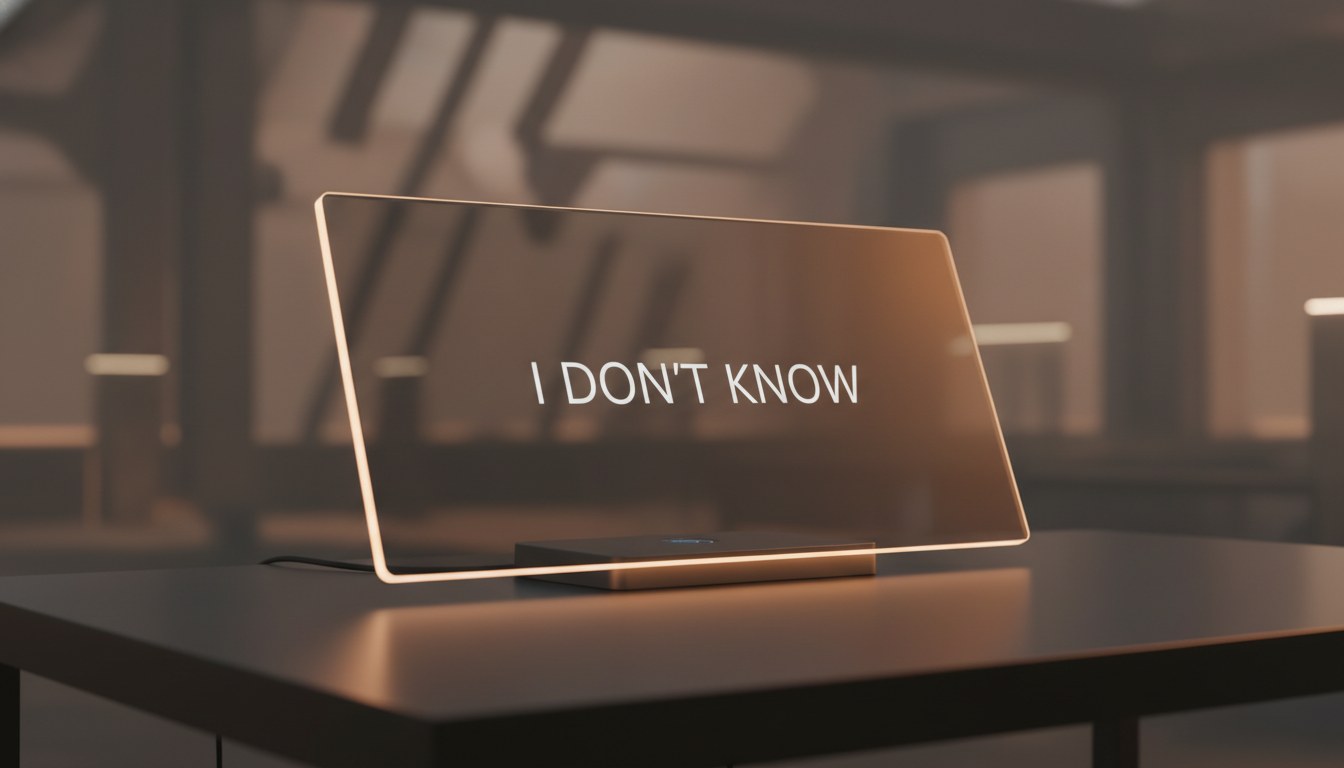
For years, AI assistants have had a peculiar compulsion: when they don't know something, they tend to make something up anyway, delivered with complete confidence. Anthropic is now pushing back against that tendency in Claude Opus 4.8, training the model to recognize the limits of its own knowledge and say so plainly.
The effort, reported by PCWorld, centers on what researchers sometimes call calibrated uncertainty. The idea is that a model should express confidence roughly proportional to how likely it is to be correct. When the answer is genuinely unclear, the model should say so rather than invent a plausible-sounding response. It sounds simple. In practice, it has proven stubbornly difficult to achieve in large language models.
Why AI Models Struggle With 'I Don't Know'
The root of the problem lies in how these models are trained. Language models learn by predicting text, and training data is full of confident, declarative statements. Expressions of uncertainty are comparatively rare, and hedging often gets penalized during fine-tuning when human raters prefer crisp, direct answers. The result is a systematic bias toward overconfidence. After Anthropic launched Claude Opus 4.8, addressing this bias became one of the model's explicit development goals.
Hallucination, the technical term for AI-generated falsehoods, has been a persistent liability across the industry. It undermines trust in high-stakes applications like legal research, medical information, and financial analysis. Users who catch a model confidently stating something false are often reluctant to rely on it again, even for tasks where it performs well.
Key Facts
- Claude Opus 4.8 is being specifically trained to express calibrated uncertainty
- The goal is to reduce hallucinations by having the model acknowledge knowledge gaps
- Overconfidence in AI responses has been linked to systematic biases in training data
- Honest uncertainty expressions are seen as critical for high-stakes professional use cases
- Anthropic frames the capability as part of broader honesty and alignment work
Anthropic has framed this work as part of its broader alignment research. The company has been trying to make Claude not just accurate but honest about accuracy. Those are related but distinct goals. A model can be accurate on average while still being dangerously overconfident on the specific questions where it happens to be wrong. Getting the model to flag its own uncertainty is, in some ways, more valuable than improving raw accuracy, because it allows users to calibrate their own trust appropriately. This connects directly to work the company has done to address other honesty-related behaviors, including Anthropic's effort to fix Claude's blackmail problem using three million tokens of training data.
Teaching a model to say 'I don't know' is deceptively hard. The model has to recognize not just what it knows, but how well it knows it, and that kind of meta-cognition is genuinely new territory for these systems.PCWorld

What This Means for Users
In practical terms, the change should surface as more frequent hedging language when Claude is uncertain, along with clearer signals when a question falls outside the model's reliable knowledge. Rather than generating a confident but potentially fabricated answer, Claude Opus 4.8 is being tuned to respond with something closer to what a careful human expert would say: here is what I know, here is where I am less certain, and here is where you should probably verify independently.
That kind of response is less immediately satisfying than a crisp answer, but it is far more useful in professional contexts. It also makes Claude a more trustworthy collaborator over time, since users can begin to rely on its confidence signals rather than having to independently verify every output. Across Claude's model family, Anthropic has been pushing toward this kind of honest, calibrated communication as a defining characteristic rather than a secondary feature.
The move also carries commercial implications. Enterprise customers, who represent a growing share of Anthropic's business as the company pushes toward major revenue targets, are particularly sensitive to hallucination risk. A model that knows what it doesn't know is substantially easier to deploy responsibly in production environments. Whether this training approach translates cleanly into measurable reductions in real-world errors remains to be seen, but the directional commitment is clear. Anthropic is betting that honesty, including the admission of ignorance, is a competitive advantage, not a weakness.


