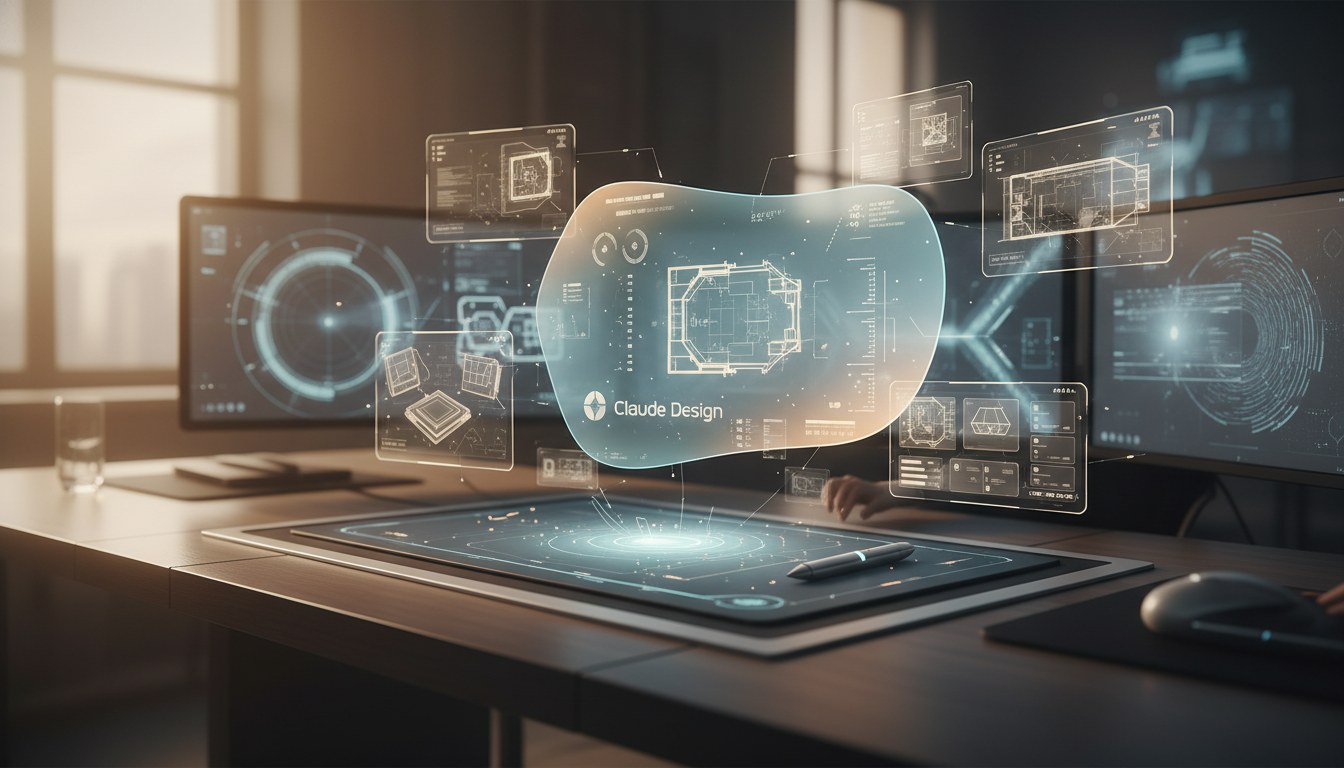
On April 17, 2026, Anthropic's experimental Anthropic Labs division released Claude Design, a new visual workspace that converts plain-text prompts, uploaded documents, and code repositories into polished prototypes, slide decks, and one-pagers. The product is included with Claude Pro, Max, Team, and Enterprise subscriptions at no extra charge within plan limits, and is powered by Claude Opus 4.7, Anthropic's most capable publicly available vision model.
A Design Tool Built Around Conversation
Claude Design accepts inputs in three forms: a text description of what the user wants to build, uploaded files in various formats including images and PDFs, or a direct link to a code repository. From those starting points, the model generates an initial visual layout. Refinement works through a mix of channels: chat-based conversation with Claude, inline comments pinned to specific elements, direct text editing, and custom adjustment sliders that Claude itself generates for each project to let users tune spacing, color, and composition in real time without re-prompting from scratch.
A web capture tool lets users pull visual elements from a live website, so prototypes can be made to look like the actual product rather than a generic wireframe. The visual understanding that underpins this capability comes from the same Opus 4.7 architecture that gives Claude its 2,576-pixel image resolution. For enterprise accounts, Claude Design reads a team's codebase and design files during an initial onboarding step and extracts a design system, capturing colors, typography, and the component library, which it then applies automatically to every subsequent project in that workspace.
Key Facts
- Launch dateApril 17, 2026
- Underlying modelClaude Opus 4.7
- Subscriber accessPro, Max, Team, Enterprise
- Output typesPrototypes, slides, one-pagers, marketing collateral
- Export formatsPDF, PPTX, HTML, Canva, internal URL
- Design system integrationReads codebase and design files on first use

Complementing, Not Replacing, Figma and Canva
Anthropic is deliberate about framing Claude Design as a complement to existing design software rather than a replacement. The product includes a direct Canva handoff, where exported slide decks and presentation assets become fully editable collaborative documents in Canva's workspace. Export paths also cover PDF, PPTX, and standalone HTML. The Figma comparison comes up because AI design tools invite it, but Anthropic positions Claude Design as winning the moment before a traditional design tool becomes necessary: when an idea exists only in someone's head or in a rough written document and needs to become something shareable fast.
The target user is not a designer. It is a founder assembling an investor pitch at the last minute, a product manager building a feature specification, or a marketing team that needs campaign collateral by end of day. Those users are not likely to open Figma, and the workflow Claude Design is optimizing for, from text description to a polished shareable visual in a few minutes, is one that existing tools handle poorly or not at all.
"Claude Design is not meant to stand in for Figma or Canva. It is trying to win the moment before the traditional design tool becomes necessary." Anthropic, Claude Design launch announcement, April 2026
The Handoff to Claude Code
The feature that most distinguishes Claude Design from the wave of AI design tools that appeared over the past year is what Anthropic calls the handoff bundle. When a design is ready to move into development, the tool packages all visual assets and specifications into a structured bundle that can be passed to Claude Code with a single instruction. The result is a closed loop: a user can describe an idea in plain text, iterate on it as an interactive prototype through Claude Design, and then hand the finished design directly to Claude Code for implementation, all without leaving Anthropic's product suite or manually reconstructing design intent for an engineer.
That integration matters more than any individual design feature. Standalone AI design tools are useful but isolated, and their output typically has to be translated by hand before it becomes something a developer can build from. Claude Design's connection to Claude Opus 4.7 and Claude Code means the prototype and the implementation share a single structured artifact from the start. Whether that closed loop proves durable enough to shift behavior away from incumbents will depend on how the product matures past its research-preview stage, but the distribution advantage of building inside the existing Claude platform gives Anthropic a head start that most standalone tools cannot easily replicate.