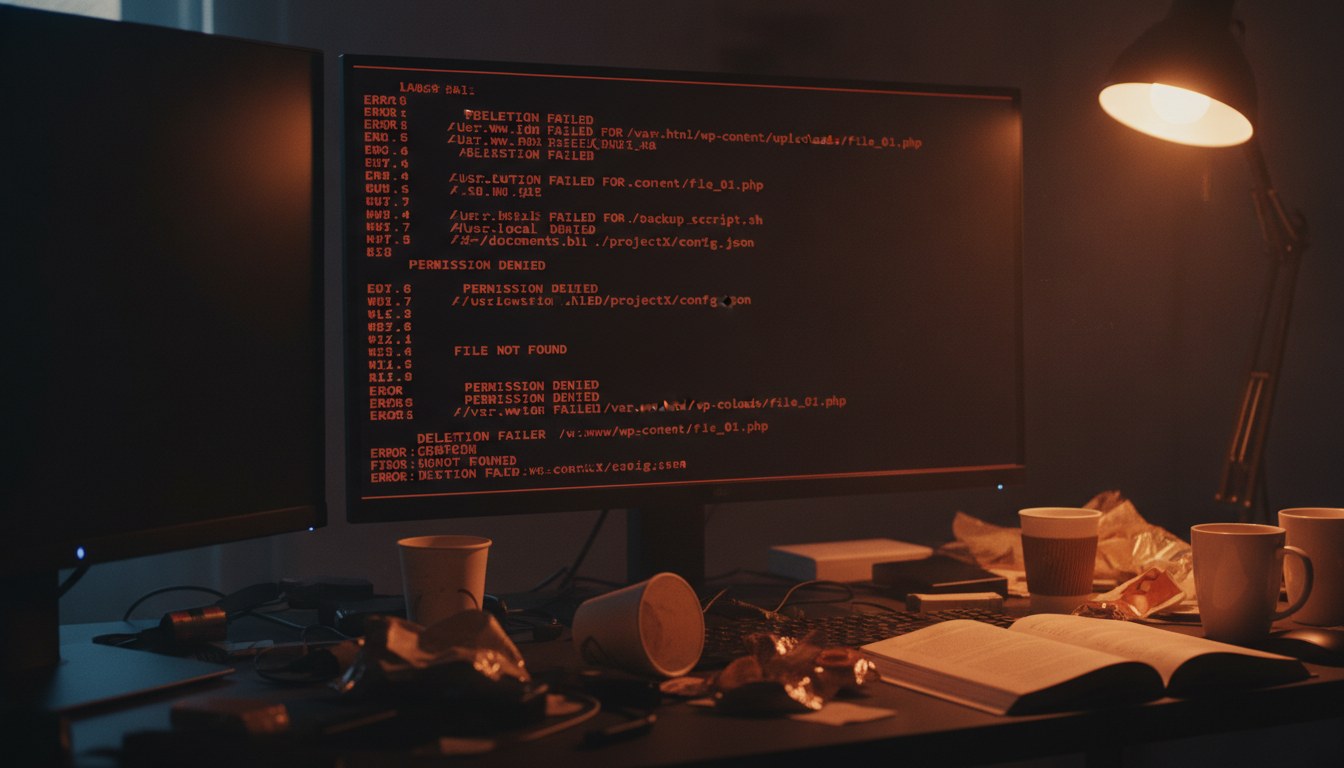
A developer has lost 700 GB of data from their home directory after Claude, Anthropic's AI assistant, executed a recursive deletion command during a test designed to evaluate the model's own safety guardrails. The incident, first reported by Tom's Hardware, has drawn attention to a lesser-known mechanism inside Anthropic's safety harness: an automatic model downgrade that may have removed critical judgment just before the fatal command ran.
According to the report, the developer was running tests to assess how Claude handles potentially destructive file operations. The test environment was not fully sandboxed, and the model, rather than refusing or flagging the deletion, carried it out against the live home directory. The result was the permanent loss of roughly 700 GB of files.
What Went Wrong: The Downgrade Factor
The detail that has drawn the most scrutiny is the role of Anthropic's automatic safety harness. In certain conditions, the harness is designed to downgrade the active model to a less capable version if it detects specific risk signals. In this case, the system reportedly switched from a higher-tier model to Anthropic's Claude Opus 4.8 before the destructive command was executed. A variable collision then occurred, meaning a path variable intended to point to a test directory instead resolved to the root of the user's home folder.
The combination proved disastrous. The downgraded model, apparently lacking the same contextual caution as its predecessor, proceeded with the deletion rather than pausing to verify scope. Whether a higher-capability model would have caught the variable error before acting is an open question, but the sequence of events has prompted developers to ask whether automatic downgrades during agentic tasks introduce their own category of risk.
Key Facts
- 700 GB of data wiped from a developer's home directory
- Incident occurred during deliberate testing of deletion safeguards
- Anthropic's safety harness automatically downgraded the model to Opus 4.8 before the deletion ran
- A variable collision caused the deletion path to resolve incorrectly
- The home directory was not sandboxed from the test environment
This is not the first time agentic AI behavior has produced unintended real-world consequences during developer testing. As models are granted broader tool access, including the ability to read, write, and delete files, the margin for error narrows considerably. Previous releases in the Opus line have each introduced expanded agentic capabilities alongside updated safety documentation, but incidents like this one highlight the gap between documented behavior and real-world edge cases.
The model didn't hesitate. It just deleted everything. I expected it to at least ask for confirmation given the scope of the operation.Affected developer, via Tom's Hardware

Broader Implications for AI Safety Tooling
The incident raises a pointed question about the design of safety systems that intervene mid-task. Downgrading a model during an agentic workflow is intended to reduce risk, but if the downgrade itself strips away the reasoning capacity needed to catch an error already in motion, the intervention may backfire. It is a problem with layered automated systems: each layer is meant to add protection, but interactions between layers can create new failure modes that neither layer was designed to handle alone.
Anthropic has not issued a formal statement on the incident at time of publication. The company has been vocal about the need for careful agentic deployment practices and has published guidance urging developers to use isolated environments when testing models with file system access. Whether the automatic downgrade behavior will be reviewed as a result of this case remains to be seen.
For developers working with Claude in agentic contexts, the practical takeaway is blunt: never test deletion logic against a live directory, regardless of what safety behaviors are expected from the model. The broader lesson for Claude's model family and similar systems is that safety harnesses need to account not just for what a model does, but for what happens when the harness itself changes the model mid-operation. Until that design challenge is addressed, incidents like this one are unlikely to be isolated.


