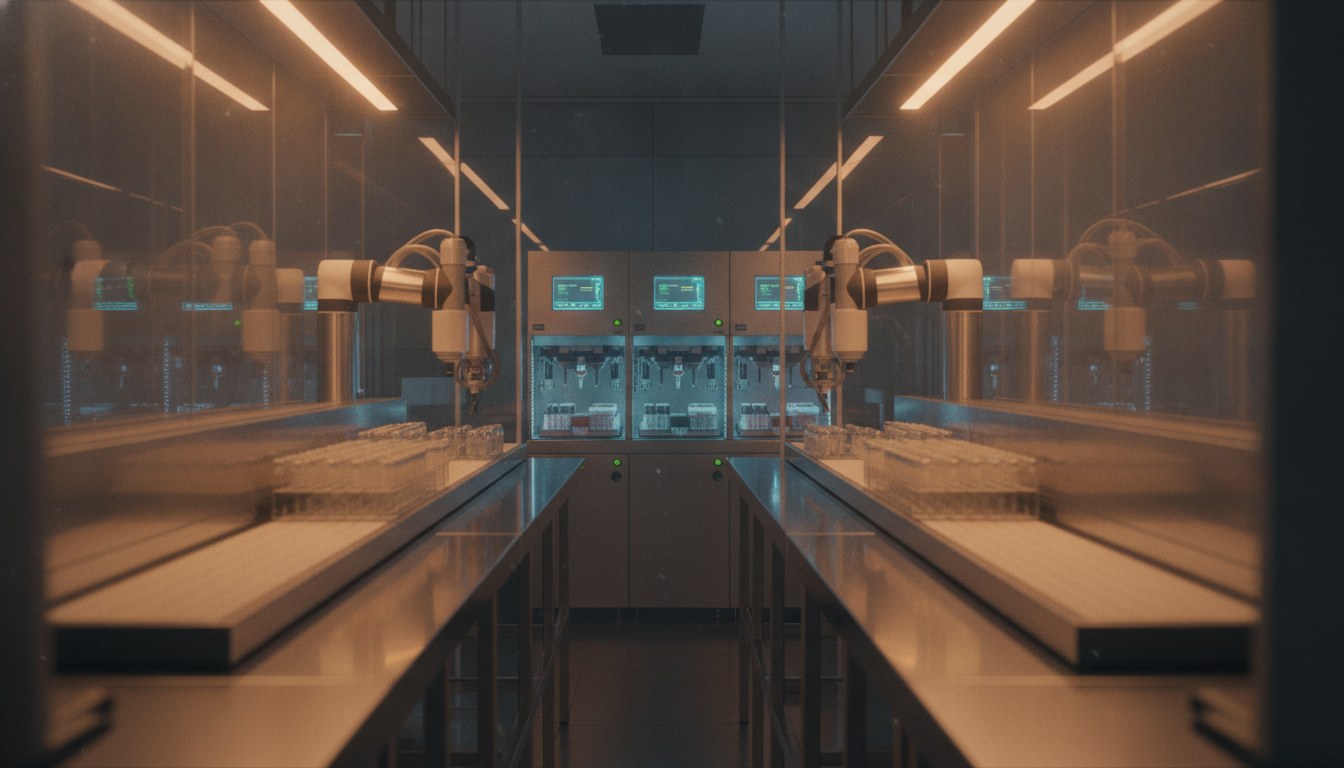
Anthropic's Claude AI has crossed into new territory: the ability to independently operate physical laboratory equipment and carry out scientific experiments from start to finish. Reported by SingularityHub, the capability allows Claude to interact with lab hardware, design experimental steps, and collect results without requiring a human to manage each action along the way. It is a concrete expansion of agentic AI into the physical world of science.
What Autonomous Lab Control Actually Means
The system works by connecting Claude to robotic lab instruments through software interfaces, giving the model the ability to send commands, monitor readings, and adjust procedures based on what it observes. This is not a simulation. Claude is directing real equipment, handling real samples, and producing real data. The degree of autonomy involved puts this well beyond AI acting as a research assistant that summarizes papers or drafts protocols. This is AI as an active participant in the experimental process itself. Anthropic has been targeting the pharma and life sciences market with dedicated science-focused offerings, and this development fits squarely within that strategy.
Key Facts
- Claude can now autonomously control physical laboratory equipment
- The system executes multi-step experimental workflows without human intervention at each stage
- Agentic capabilities are central to the integration, allowing Claude to respond to real-time data
- The development aligns with Anthropic's push into scientific and pharmaceutical research markets
- Safety guardrails remain part of the design, limiting actions Claude can take autonomously
The implications for research throughput are significant. Running experiments traditionally demands constant researcher attention, particularly during repetitive phases like liquid handling, incubation timing, or iterative sample processing. Offloading those steps to an AI system that can operate around the clock could compress timelines that currently take weeks. Small research teams with limited personnel stand to benefit most, since the bottleneck is often human availability rather than equipment capacity.
The ability to close the loop between AI reasoning and physical experimentation is one of the most consequential steps we can take toward accelerating scientific discovery.SingularityHub

Agentic AI Moving Into the Physical World
This latest capability is part of a broader pattern in how Claude is evolving. Claude has already gained the ability to send emails without asking for confirmation each time, and agentic features that allow it to act on behalf of users in digital environments have been expanding steadily. Lab automation extends that same logic into physical infrastructure. The model is no longer just generating text or analyzing data handed to it. It is initiating actions with real-world consequences, which raises the stakes on both reliability and oversight.
Anthropic has consistently framed its agentic development work around what it calls responsible scaling, emphasizing that AI systems taking actions in the world need tighter reliability standards than those that simply produce text outputs. For lab automation specifically, an error in a digital task might mean a wrong email or a misread file. An error in an experimental workflow could mean contaminated samples, wasted reagents, or misleading data that propagates through a research program. The company appears aware of this distinction and has built constraint layers into how Claude operates equipment.
For now, deployments appear to be in controlled research contexts rather than fully open environments. But the direction is clear. As AI models become more capable of chaining together complex multi-step tasks and responding dynamically to what they observe, the range of scientific work they can handle will grow. Routine assays, screening campaigns, and data collection workflows are the near-term targets. More complex experimental design and hypothesis generation remain areas where human researchers retain the primary role, at least for the moment.
Whether this reshapes research staffing, accelerates drug discovery timelines, or introduces new categories of experimental error is still an open question. What is no longer an open question is that AI operating physical lab equipment has moved from a speculative idea into something happening today.


