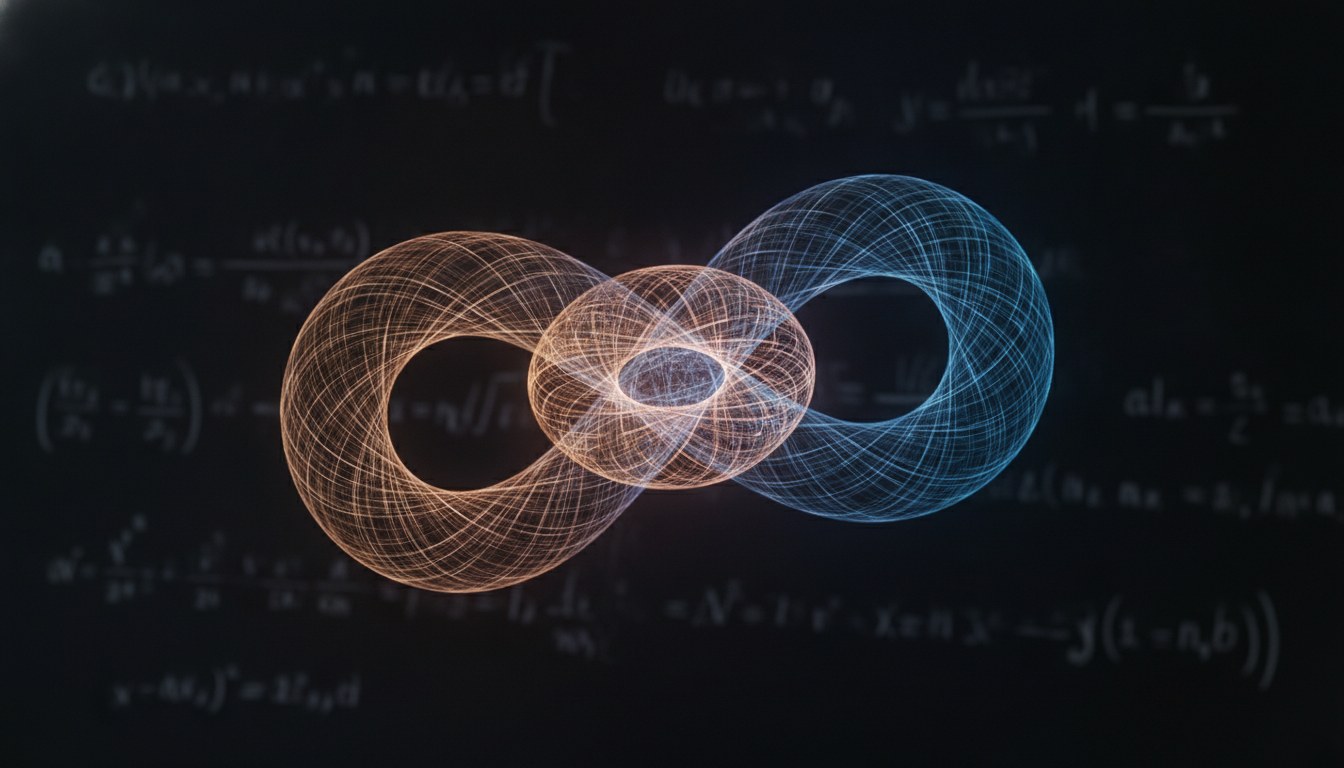
Anthropic's Claude AI has broken a long-standing mathematical record, constructing what researchers are calling the most complicated curve ever produced. The achievement, reported by Scientific American, sees an artificial intelligence system outperform human mathematicians on a problem that sits at the frontier of pure mathematics. It is a result that few would have predicted even a year ago, and it raises fresh questions about the role AI might play in advancing foundational science.
What the Record Actually Means
The record involves a specific class of mathematical curves measured by their complexity, typically quantified through properties like the number of self-intersections or the intricacy of their topology. Constructing a curve that beats existing records is not a matter of brute computation alone. It requires a combination of creative problem-solving and rigorous verification, areas where large language models have historically struggled. Claude's success suggests the model is doing something more than pattern-matching on training data. Anthropic has previously outlined an ambitious vision for Claude's role in scientific research, and this result appears to be a concrete step in that direction.
Key Facts
- Claude AI constructed a curve verified to be more complex than any previously recorded by human mathematicians.
- The result was reported in Scientific American, lending it significant scientific visibility.
- Complexity in this context relates to topological and geometric properties of the curve, not simply computational scale.
- The achievement follows growing interest in AI systems tackling open problems in pure mathematics.
- Anthropic has been expanding Claude's scientific capabilities over recent months.
The mathematics community has reacted with a mixture of curiosity and caution. Some researchers have noted that verifying AI-generated mathematical constructions is itself a nontrivial task. Others point out that record-setting in pure mathematics does not always translate to broader theoretical breakthroughs. Still, the fact that a general-purpose AI system produced a result that specialists had not reached is hard to dismiss. Anthropic has been building dedicated tools for scientific users, and achievements like this one give those efforts additional credibility.
An AI system contributing to record-setting mathematics is no longer a hypothetical. It is happening now, and the field needs to think carefully about what that means for how we do research.Scientific American

What This Tells Us About Claude's Capabilities
This result fits into a broader pattern of Claude demonstrating strength in technical and formal reasoning tasks. Anthropic's own 2026 coding report highlighted how context engineering has become central to unlocking the model's performance, and similar techniques may be at play in mathematical discovery tasks. When given well-structured prompts and appropriate scaffolding, Claude appears capable of exploring mathematical spaces in ways that complement, and in some cases exceed, human effort.
It is worth keeping perspective here. Breaking a record for curve complexity is a narrow result, not a signal that AI has mastered mathematics as a discipline. Pure mathematics contains vast territories of open problems where human intuition, creativity, and decades of accumulated knowledge remain essential. What this record does show is that AI systems are becoming genuine participants in certain kinds of mathematical work, rather than just tools that assist human researchers.
Anthropic has not released a detailed technical paper on this specific result as of publication, but the broader trajectory is clear. The company is investing in making Claude more capable across scientific domains, and mathematics is proving to be a productive testing ground. As verification methods improve and mathematicians develop better frameworks for collaborating with AI, results like this one may become more common. For now, the record stands, and the mathematical community has a new kind of competitor to contend with.


