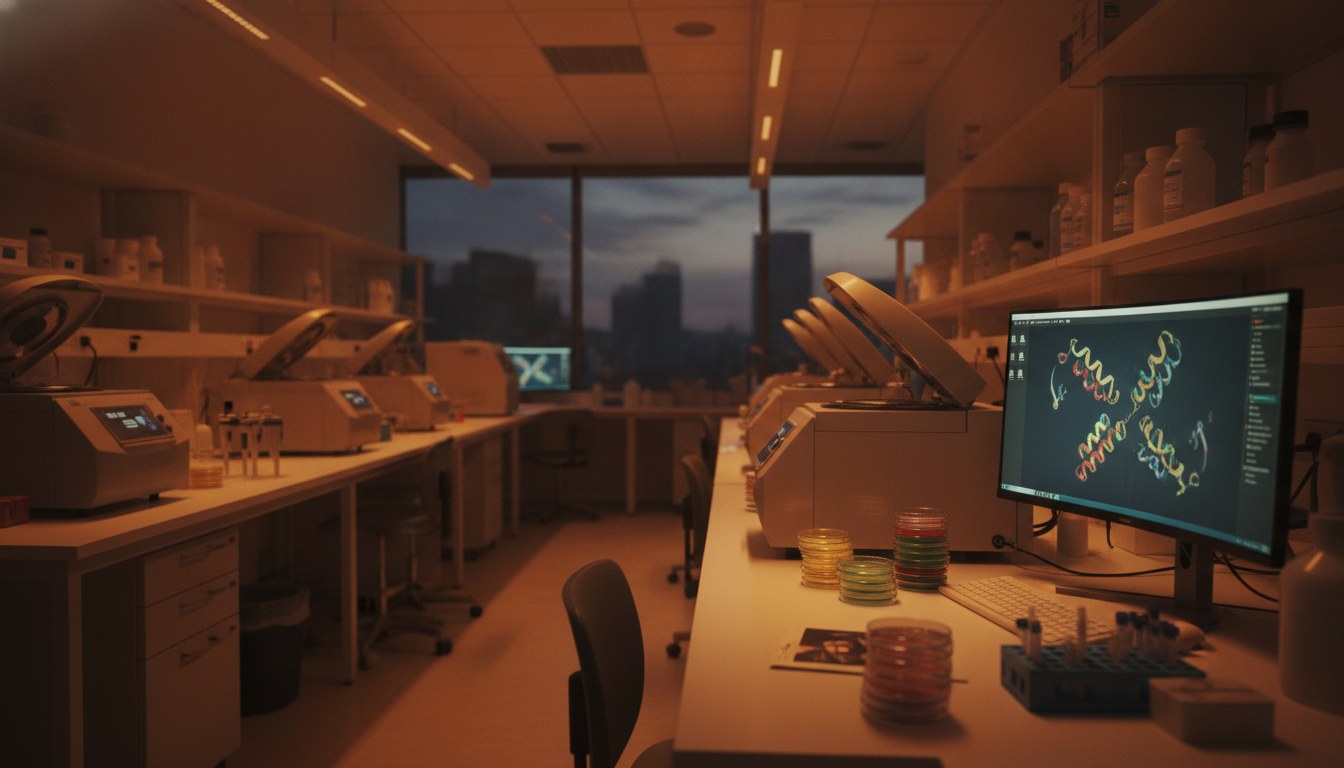
Anthropic has announced that its Claude AI assisted researchers in identifying a previously unknown enzyme system, according to a report from Reuters. The finding adds weight to arguments that large language models can move beyond text generation and contribute meaningfully to biological research. While details on the specific enzyme system remain limited, the claim positions Claude as a tool capable of parsing complex scientific literature and surfacing patterns that might otherwise take human researchers considerably longer to find.
What the Discovery Involves
The enzyme system in question appears to share structural characteristics with CRISPR-associated proteins, suggesting it may have implications for gene editing or microbial defense research. Claude's identification of a novel enzyme system with CRISPR-like repeats points toward a growing use case: using AI to cross-reference vast bodies of genomic and biochemical data faster than conventional methods allow. Researchers working in this space say the bottleneck is rarely laboratory work alone. Synthesizing existing literature to form new hypotheses is where time is most often lost.
Key Facts
- Anthropic credits Claude with helping identify a novel enzyme system in a research setting.
- The system reportedly shares features with CRISPR-associated proteins.
- The announcement was first reported by Reuters and attributed to Anthropic directly.
- No peer-reviewed publication has been cited as of this writing.
- The finding follows Anthropic's broader push into scientific and pharmaceutical markets.
The announcement fits a pattern Anthropic has been building toward. Earlier this year, the company moved to position Claude more directly within life sciences workflows, launching tools aimed at the pharmaceutical sector. Anthropic's Claude Science initiative targets pharma revenue by offering specialized research capabilities to drug developers and biotech firms. An enzyme discovery credited to AI, even partially, serves as a tangible proof point for that strategy.
Artificial intelligence systems that can read and reason over scientific literature at scale may compress research timelines in ways that were not possible even five years ago.Industry analysts commenting on AI in biological research
Skepticism and Open Questions
Not everyone is ready to treat this announcement as settled science. Without a peer-reviewed study attached, it is difficult to independently assess how central Claude's role was versus serving as a research aid. The line between AI as an analytical tool and AI as a genuine co-discoverer is one researchers and institutions are still working to define. Anthropic has an obvious interest in promoting high-profile use cases for its models, and claims about scientific breakthroughs without published methodology tend to draw scrutiny from the academic community.
That said, this is not the first time Claude has been associated with findings in this area. Reports covering Claude's involvement in identifying a CRISPR-like enzyme system have circulated across research communities, suggesting the story has been developing across multiple steps rather than appearing suddenly. Whether the underlying science holds up to peer review will matter far more than any press release in the long run.
A Broader Shift in AI Research Tools
The announcement reflects a broader industry trend. AI companies are increasingly eager to demonstrate that their models can do more than summarize text or write code. Biology and chemistry present particularly compelling test cases because the datasets are large, the literature is dense, and the potential payoffs from accelerated discovery are enormous. Claude competing in this space puts it alongside tools from companies like Google DeepMind, whose AlphaFold protein structure predictions reshaped structural biology.
For Anthropic, the timing is deliberate. The company has been expanding Claude's role in professional and scientific settings, and an enzyme discovery tied to CRISPR-adjacent biology lands in one of the most commercially active areas of life sciences research. Whether this becomes a recurring story of AI-assisted discovery or a one-time headline will depend on what independent researchers can verify and reproduce in the months ahead.