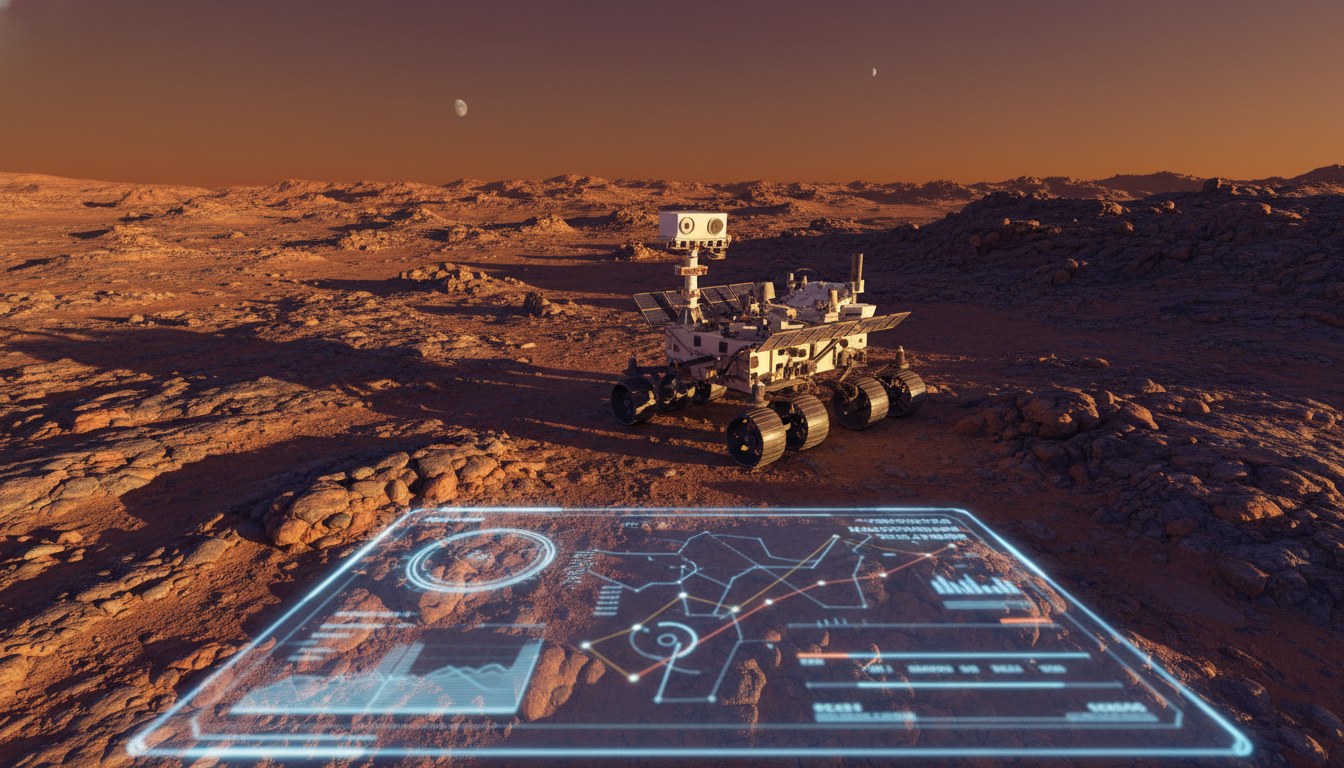
NASA has successfully completed what it describes as the first Mars rover drive planned by an artificial intelligence system, with Anthropic's Claude AI handling the route planning autonomously. The development, announced by Anthropic, signals a meaningful shift in how space agencies might manage planetary exploration as communication delays between Earth and Mars make real-time human guidance impractical.
How Claude Was Put to Work on Mars
Operating a rover on Mars has always been a slow, methodical process. The communication delay between Earth and Mars can stretch from roughly three minutes to over twenty minutes each way, depending on planetary alignment. That gap forces mission teams to plan drives carefully in advance, uploading instructions and waiting hours to see results. Introducing an AI model into that planning loop offers the possibility of faster iteration and more efficient use of rover time on the surface.
In this case, Claude was used to analyze terrain data and generate a drive plan for the rover, with the AI taking on the kind of route optimization work that human operators have traditionally handled manually. The specifics of which rover was involved and the exact scope of Claude's planning role were disclosed by Anthropic as part of the announcement.
Key Facts
- Claude AI planned a Mars rover drive autonomously, a first for AI systems in planetary exploration
- Communication delays of up to 40 minutes round-trip make autonomous planning valuable for Mars operations
- Anthropic announced the collaboration, highlighting Claude's use in a high-stakes scientific context
- The development builds on broader industry interest in applying large language models to complex scientific workflows
The application fits a pattern of AI models being tested in environments where decisions carry real consequences and where human oversight, while still present, cannot be immediate. Space exploration is an area where the constraints are physical and absolute. You cannot simply pause and ask a human to weigh in when the rover is already moving across terrain millions of miles away.
This represents a new frontier for AI-assisted science, where models like Claude can take on planning tasks in environments that are fundamentally inaccessible to direct human intervention in real time.Anthropic

What This Means for AI in Scientific Settings
The NASA collaboration adds weight to Anthropic's positioning of Claude as a capable tool for technical and scientific work. Claude's model family has been developed with an emphasis on careful reasoning and reliability, qualities that matter considerably when the cost of an error is a stranded rover or a missed scientific opportunity on another planet.
For NASA, the appeal of AI-assisted planning is straightforward. Rover missions are expensive and the science windows are finite. Any system that can help teams move faster or squeeze more observations out of a given sol, the Martian day, is worth evaluating seriously. Using Claude to handle drive planning is one way to test whether current AI capabilities are ready for that kind of responsibility.
It is worth noting that this does not mean human mission controllers are being removed from the picture. AI planning in this context works alongside human teams, not in place of them. Controllers can review and override AI-generated plans before they are executed. The question being explored is how much of the routine cognitive work AI can absorb, freeing human experts to focus on higher-level decisions.
Anthropic has been expanding Claude's presence in enterprise and scientific applications, backed by significant investment. The company's Series F funding has supported that expansion into sectors where accuracy and trustworthiness are non-negotiable. A successful NASA collaboration offers a concrete data point in that effort, one that is difficult to dismiss given the stakes involved in planetary science missions.
Whether this becomes a routine part of Mars operations or remains a proof-of-concept for now, the underlying signal is clear. AI models are moving into applied scientific roles where their outputs have direct physical consequences, and the space sector is paying attention.