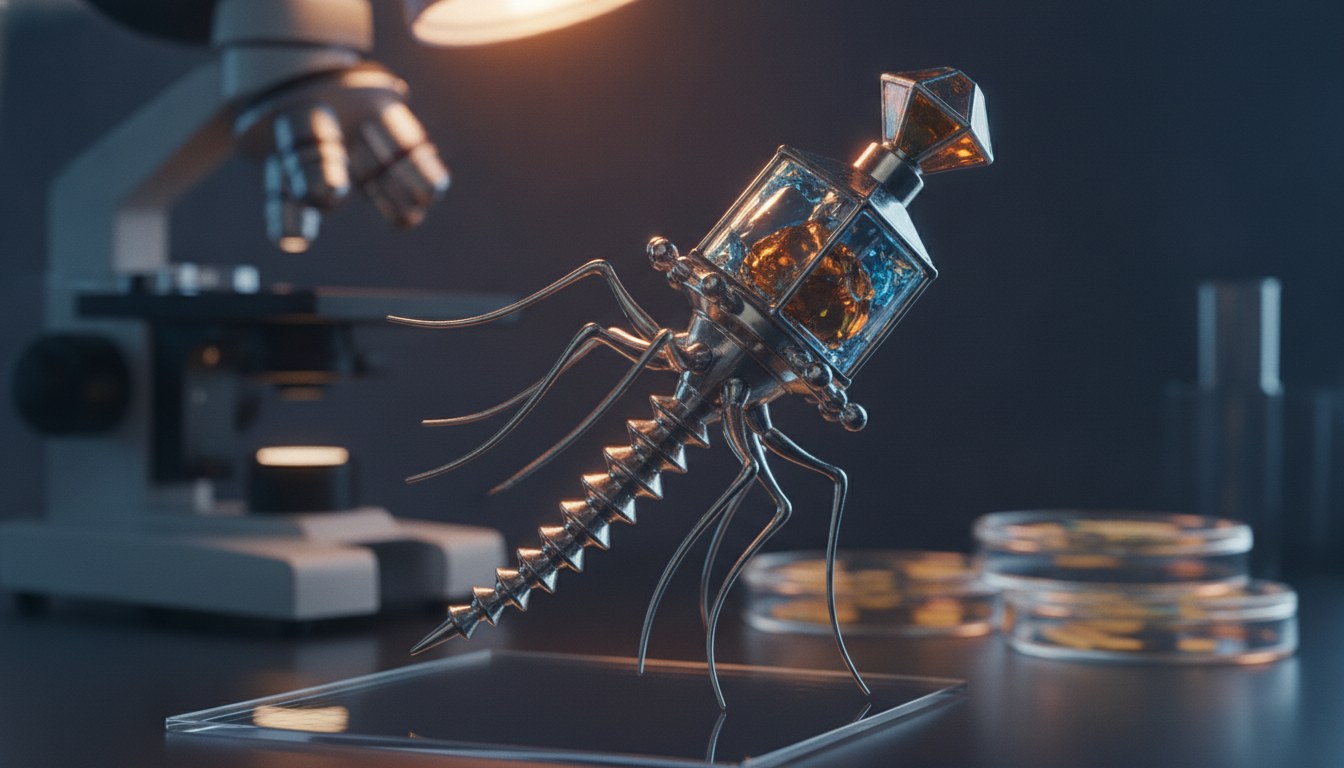
Anthropic's Claude AI has identified a previously unknown enzyme system in bacteriophages, the viruses that infect bacteria, adding a concrete scientific result to the growing conversation about AI's role in biological discovery. The finding was highlighted by Anthropic CEO Dario Amodei as an example of what large language models can contribute when pointed at complex scientific problems.
What Was Found and How
The enzyme system identified by Claude appears to be distinct from known mechanisms in bacteriophage biology. Researchers working with the model used it to analyze large volumes of genomic data, allowing it to surface patterns and candidate structures that human scientists had not previously catalogued. This type of analysis, scanning enormous datasets for meaningful signals, is where AI systems have shown consistent value in recent months. Coverage of a closely related finding can be found in our earlier report on how Claude discovered a novel enzyme system with CRISPR-like repeats, which provides useful background on the methodology involved.
Key Facts
- Claude identified the enzyme system by processing large-scale bacteriophage genomic data
- The system is described as distinct from previously catalogued mechanisms in phage biology
- CEO Dario Amodei cited the discovery publicly as evidence of AI's scientific utility
- The finding builds on earlier Claude-assisted research into CRISPR-adjacent biological structures
- Anthropic has been positioning Claude as a tool for accelerating scientific work across disciplines
Bacteriophages are among the most abundant biological entities on Earth and have long been studied for their potential in medical applications, including as alternatives to antibiotics. Identifying new enzyme systems within them could have downstream implications for biotechnology and medicine, though researchers are careful to note that basic discovery and practical application are separated by years of additional work.
We believe AI is going to be one of the most powerful tools humanity has ever had for scientific discovery. This is just one early example of what that looks like in practice.Dario Amodei, CEO, Anthropic

Amodei's Broader Framing
Amodei has been vocal in recent weeks about his view of AI's potential impact on science and the economy. His comments about this enzyme discovery fit a pattern of public statements in which he attempts to ground optimistic projections in specific, verifiable outputs. Earlier this year, he drew attention for remarks about AI's effect on white-collar employment, as covered in our piece on how Amodei shifted tone on AI job risk at a Wall Street briefing. The scientific discovery angle represents a different, more positive register for the same underlying argument: that AI systems are becoming capable of doing consequential work.
Anthropic has framed Claude's scientific capabilities as a core part of the model's value, distinct from general productivity use cases. The company has pointed to biology and chemistry as fields where the model's ability to process and reason over dense technical literature gives it particular leverage. This latest announcement reinforces that positioning, though independent peer review of the enzyme finding has not yet been publicly confirmed.
The discovery also arrives at a moment when AI companies are under pressure to demonstrate that their systems produce real-world value beyond text generation. A concrete biological finding, if it holds up to scrutiny, is the kind of outcome that resonates beyond the technology sector. For those tracking the pace of AI-assisted science, this adds to a short but growing list of cases where models like Claude have contributed something new rather than simply summarizing what already exists. Readers following these developments can keep up with the latest Claude AI news as the story continues to develop.
“Claude just proved it can operate as a genuine scientific collaborator, not a search tool, and organisations investing in AI literacy now will be the ones positioned to direct these discoveries rather than simply consume them.”
Leon Tindemans, AI expert and entrepreneur specialising in Claude, Copilot and ChatGPT. Learn more with ChatGPT training by TTM Communicatie.


