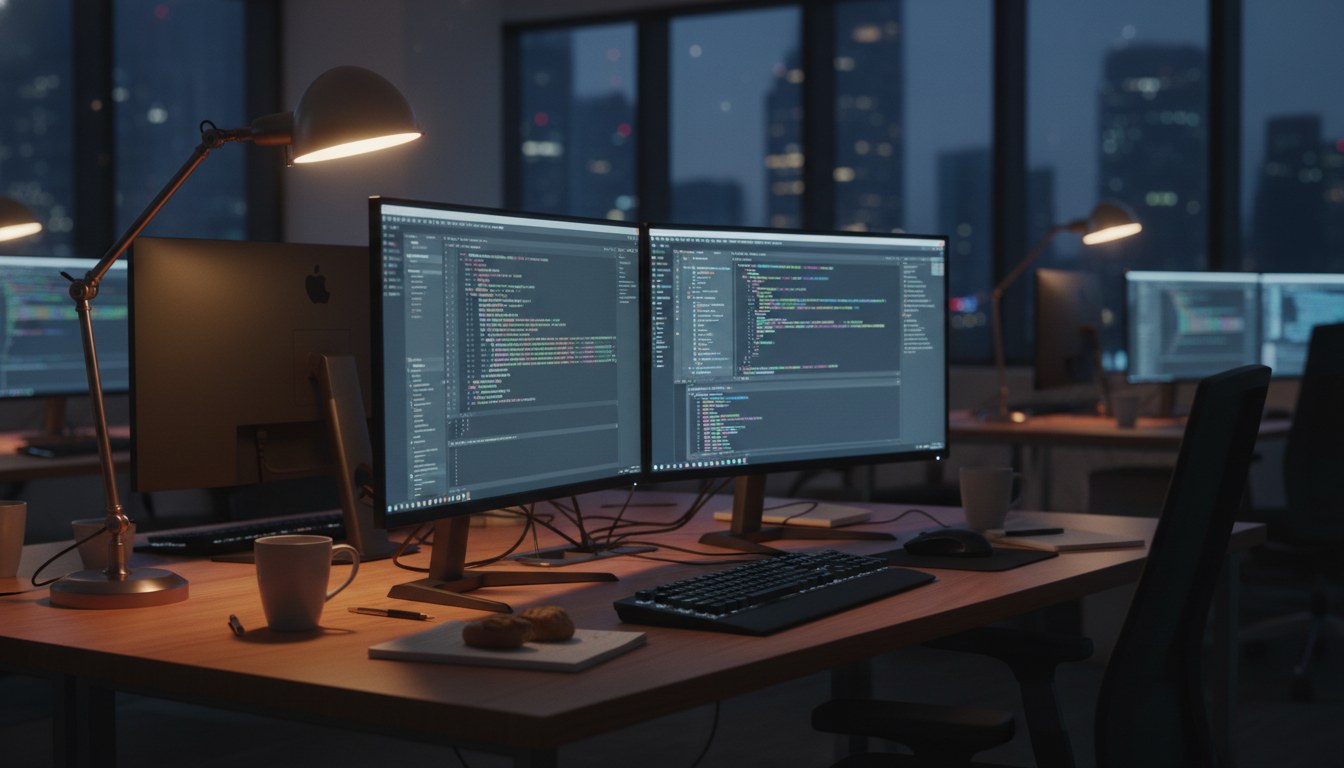
Boris Cherny built Claude Code. He has not typed a line of production code himself in eight months. Speaking on Monday at the opening session of Fortune's 25th annual Brainstorm Tech conference in Aspen, the creator and head of Anthropic's most-used developer product described a workday that most engineers would have considered science fiction two years ago. "This morning I was managing maybe a few hundred," he told the audience, referring to the AI agents running autonomously under his supervision. "Some days it's thousands, or tens of thousands."
From One Terminal to Ten Thousand Agents
The shift Cherny described is not cosmetic. A year and a half ago, Claude Code was a single process in a single terminal window: a developer typed a prompt, Claude responded, work moved forward. That model is now largely obsolete inside Anthropic itself. Today, when Cherny opens a task, he is likely spinning up a hierarchy. "You have a Claude Code, but it has subagents that are other Claudes," he explained. The orchestrator Claude plans the work, breaks it into subtasks, and delegates to child agents. "It's actually another Claude that does the prompting." The human is not writing the sub-prompts. The system is.
The practical result of that architecture is a throughput that bears no resemblance to traditional software development. Anthropic has said elsewhere that Claude now authors more than 80 percent of the code merged into its own codebase. Cherny put a finer point on what that means at the team level: since the start of 2026, the amount of code produced at Anthropic has grown eight times over, with the same number of engineers. Claude Code is not replacing developers. It is running entire workstreams in parallel while developers review outputs, redirect priorities, and catch things the agents miss.
Key Facts
- Months since Cherny wrote code by hand8
- AI agents Cherny manages on peak daysTens of thousands
- Increase in Anthropic code output since Jan 20268x
- Share of Anthropic production code written by Claude80%+
- Claude Code GitHub stars as of June 2026131,000+
- ConferenceFortune Brainstorm Tech 2026, Aspen
When the Tool Builds Itself
The detail that drew the most attention in the room was not the agent counts. It was what Claude Code is doing with its time. Cherny said the system has moved past pure execution and into something that looks closer to initiative. "We're starting to get to the point where it has ideas," he said. "It's looking at GitHub, it's looking at X; it's figuring out, 'What should I build next?'" In practice, this means engineers at Anthropic sometimes arrive in the morning to find that Claude Code has already identified a gap, drafted a fix, run tests against it, and left the output waiting for review. The work happened while the team was asleep.
Claude Code now writes its own updates, including security reviews of those updates, in a loop that Cherny described as an almost fully closed system. The dynamic workflows feature Anthropic shipped alongside Claude Opus 4.8 in May formalized much of this: developers can now invoke "ultracode" mode to hand the orchestration problem to Claude entirely, with the model deciding when to spawn parallel agents, how many to run, and how to reconcile their outputs. What Cherny showed at Brainstorm Tech is that Anthropic's own engineers have been living with an informal version of that loop for months.
"We're starting to get to the point where it has ideas. It's looking at GitHub, it's looking at X; it's figuring out, 'What should I build next?'" Boris Cherny, Fortune Brainstorm Tech 2026, June 8, 2026
The Safety Question in the Room
The session moderator asked Cherny directly whether he was worried about what he had just described. Recursive self-improvement, the scenario in which an AI system uses its capabilities to accelerate its own development, has been a core concern in AI safety literature for decades. Cherny did not dodge the question. "It's one of the big risks for AI," he said.
That answer sits in a specific context. Anthropic published a detailed post in early June arguing that Claude's growing role in its own codebase is precisely the dynamic that motivates its call for a global option to pause frontier AI development if the pace outstrips oversight capacity. Cherny's comments at Brainstorm Tech are the operational face of that abstract warning: not a hypothetical about some future system, but a description of what is already running in production at one of the world's leading AI labs.
For enterprise developers considering Claude Code for their own organizations, the distinction matters. Anthropic positions Claude Code as a tool that amplifies engineers, not replaces them. The 8x code output figure comes with a corollary: the engineers at Anthropic are still in the loop, reviewing outputs, overriding decisions, and maintaining accountability for what ships. Whether that balance holds as agent counts scale toward tens of thousands per day is the open question Cherny left hanging in the air above Aspen. Browse Claude's model family for more on the underlying architecture that makes this scale possible.