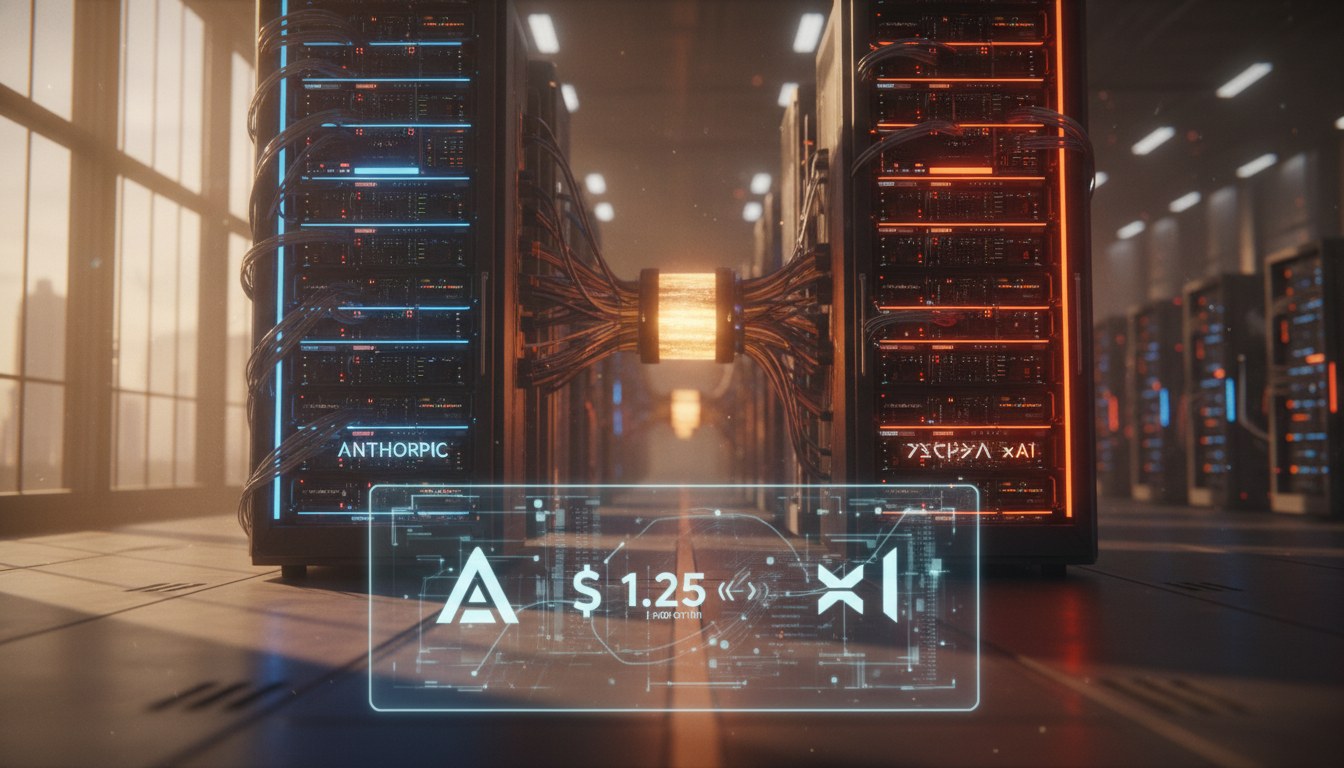
The financial terms of Anthropic's computing arrangement with Elon Musk's xAI became public this week, not through any Anthropic disclosure, but through a regulatory filing. When SpaceX submitted an S-1 registration statement to the Securities and Exchange Commission in preparation for a public offering, the document included a detail that had not been previously confirmed: Anthropic pays xAI $1.25 billion per month for access to the Colossus 1 data center in Memphis, Tennessee. The contract runs through May 2029.
At full rate, the deal could bring xAI more than $40 billion in revenue over its lifetime. TechCrunch, which first reported the specifics on May 20, noted that xAI secured a discounted rate covering the first two months of the contract, while Colossus completes its ramp-up. Either party can exit with 90 days' notice. The structure is standard for large hyperscale agreements, though the dollar figure, roughly $15 billion per year, places this among the largest single compute contracts disclosed publicly.
What the Colossus Deal Covers
Anthropic has secured the entire output of Colossus 1, a 300-megawatt facility that xAI built in Memphis primarily to train its Grok models. Taking all 300 megawatts means Anthropic has a large, dedicated computing block that does not compete for capacity with other tenants. That predictability matters for a company running inference at the scale Claude now operates. Anthropic has pursued similar long-term infrastructure agreements with other providers as a way to secure compute without building data centers itself.
The disclosure also puts a specific number on a cost that analysts had been estimating indirectly. Anthropic has acknowledged that compute is its largest single expense. One contract alone running at $1.25 billion a month makes clear why the company's revenue growth needed to be extraordinary to reach profitability. Anthropic expects to generate $10.9 billion in revenue in the second quarter of 2026, which means the xAI payment, while substantial, is a manageable fraction of incoming revenue.
The Colossus Contract
- Monthly payment to xAI$1.25 billion
- Annual rate~$15 billion
- Contract throughMay 2029
- Total potential valueOver $40 billion
- FacilityColossus 1, Memphis, Tennessee
- Capacity300 megawatts (entire output secured by Anthropic)
- Termination clause90 days' notice by either party

Grok's Loss, Claude's Gain
Colossus was built to give xAI a competitive advantage in training Grok. That logic has run into a commercial problem: Grok's usage has declined significantly in recent months as Claude and OpenAI's models have pulled ahead. The facility's capacity is now underutilized from xAI's perspective, and renting it to Anthropic converts idle infrastructure into a predictable revenue stream. Anthropic, in turn, gets access to a large cluster without the capital expenditure of building equivalent capacity from scratch.
The arrangement is commercially sensible for both companies. It is also structurally unusual: Anthropic is paying $1.25 billion a month to the infrastructure arm of a company that competes directly with Claude through Grok. Every dollar Anthropic spends on compute is, at the same time, revenue for a direct rival's parent organization. Neither company has raised public objections to that dynamic, and the contract structure makes the commercial logic plain enough.
"Anthropic secured the output of the Colossus 1 data center earlier in May, taking the entire 300 megawatts of capacity at the Memphis, Tennessee site that xAI had built to train its own models." TechCrunch, May 20, 2026
The Infrastructure Strategy Behind the Numbers
The SpaceX S-1 disclosure is a window into how Anthropic thinks about infrastructure. Rather than concentrating compute with a single provider, the company has spread capacity across Amazon Web Services, Akamai, and now xAI's Colossus. The multi-provider approach reduces the risk of any single vendor becoming a bottleneck and gives Anthropic negotiating leverage it would not have with a single-source dependency.
The $1.25 billion monthly figure also provides a useful frame for understanding why Anthropic's current $30 billion fundraising round is structured at the scale it is. Capital at this level is not speculative; it is operational. Compute costs of $15 billion per year require a revenue base that most software companies never reach, and a balance sheet capable of sustaining growth between cash collections and payments.
Where This Leaves the Market
The SpaceX filing is a reminder of how different frontier AI economics are from earlier software eras. A single infrastructure contract for a single provider costs more per year than most enterprise software companies generate in total revenue. Whether that dynamic evolves as model efficiency improves, or whether it deepens as models become more capable and usage grows, is the central financial question facing every company in the space.