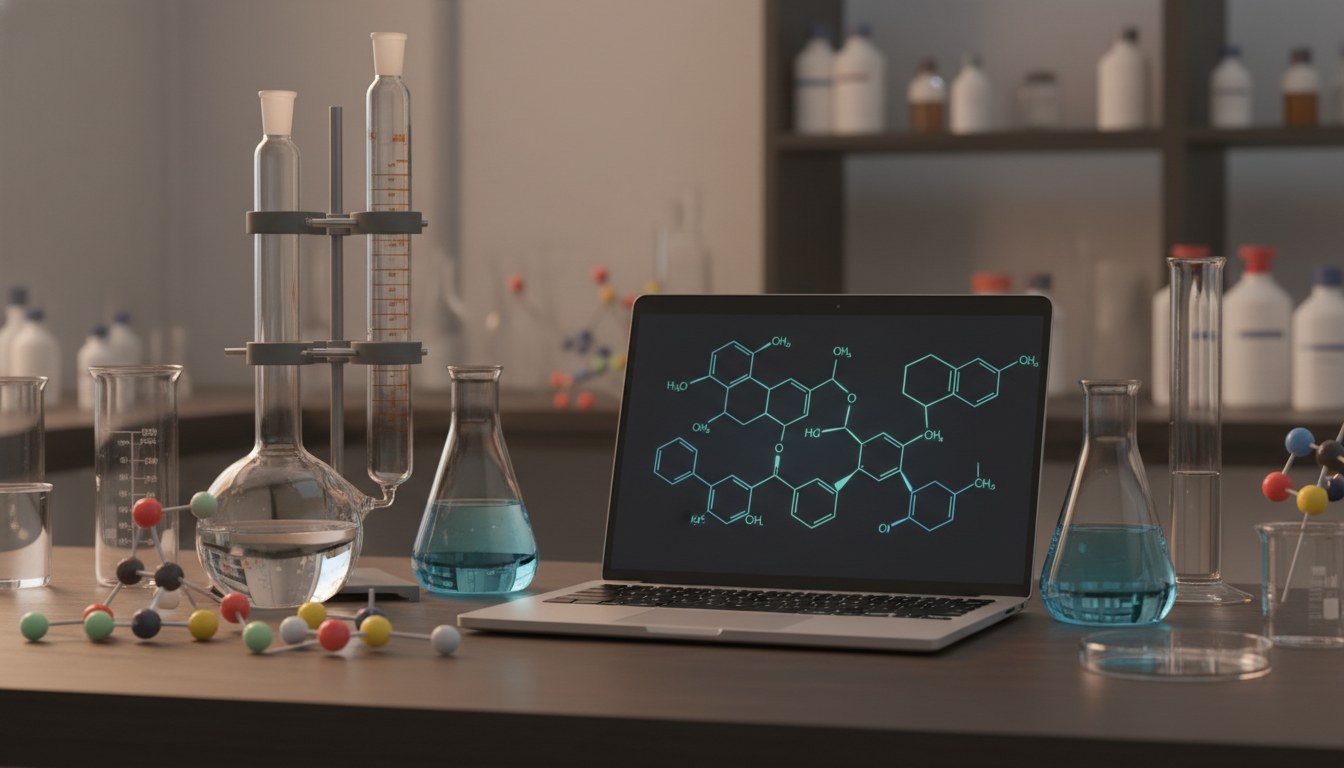
Anthropic has published research outlining its approach to building substantive chemistry capabilities into Claude, the company's flagship AI assistant. The work goes beyond simple question-answering, aiming to give Claude the ability to reason through chemical problems the way a trained scientist would, from interpreting molecular structures to evaluating reaction pathways.
What Anthropic Is Actually Building
The research describes a multi-layered effort to embed chemistry knowledge into Claude's reasoning pipeline. Rather than treating chemistry as a retrieval task, Anthropic's team focused on getting the model to understand underlying principles: stoichiometry, thermodynamics, organic mechanisms, and lab safety constraints. The goal is a model that can serve as a genuine collaborator for researchers, not just a search tool with a conversational interface. Anthropic has been steadily pushing its models into domain-specific territory, and chemistry represents one of the more demanding tests of structured scientific reasoning.
Key Facts
- Anthropic is integrating deep chemistry reasoning into Claude, covering molecular structures, reactions, and laboratory workflows.
- The approach prioritizes mechanistic understanding over pattern-matching or rote recall.
- Safety considerations are built into the training, including awareness of hazardous compounds and reactions.
- The work is positioned as a foundation for scientific research assistance across chemistry disciplines.
- Claude's chemistry capabilities are intended for use in both academic and industrial research settings.
Safety is a thread running through the entire project. Anthropic is explicit that chemistry knowledge carries real-world risk, and the team has built guardrails around hazardous synthesis pathways and dangerous compound combinations. This dual focus, capability paired with constraint, reflects a tension the company navigates across all its model development work. For context on how Claude is deployed in professional settings, PwC's deployment of Claude across enterprise operations offers one example of how domain-specific capability translates into real workflows.
The ambition is to create a model that can engage with chemistry at the level of a knowledgeable collaborator, capable of working through problems rather than simply retrieving information.Anthropic research blog

Why Chemistry, and Why Now
Chemistry sits at an interesting intersection for AI development. It is highly structured, with formal rules governing reactions and naming conventions, but it also demands intuition built from years of practical experience. Large language models have historically struggled with this mix. They can reproduce facts reliably but often fail when problems require chaining multiple chemical concepts together under real constraints.
Anthropic is not alone in pursuing scientific AI. The race to build models that can support drug discovery, materials science, and industrial chemistry has intensified across the industry. Broader investment trends reinforce the stakes: Google's commitment of up to $40 billion to Anthropic signals that backers expect the company to compete at the frontier of applied science, not just general-purpose conversation.
For researchers in academia or industry, the practical question is whether Claude's chemistry reasoning holds up under scrutiny. Anthropic's internal evaluations suggest meaningful progress, but independent benchmarking by the scientific community will ultimately determine how useful these capabilities are in practice. The company appears to be inviting that scrutiny, framing this as foundational work rather than a finished product.
What is clear is that Claude's model family is being pushed into increasingly specialized territory. Chemistry is one of the harder domains to crack, requiring precision that general language models rarely achieve out of the box. Whether this research translates into a tool that working chemists actually trust is a question that will play out over months of real-world use.


