Anthropic's confidential IPO filing on June 1 turned attention toward the obvious questions: at what price would shares list, which underwriters won the mandate, and whether a near-trillion-dollar valuation could hold in public markets. A quieter conversation happening alongside those is about which companies outside Anthropic stand to gain the most when the IPO proceeds are spent. The answer points toward a cluster of AI infrastructure suppliers whose revenues are directly tied to the physical compute Anthropic has contracted to buy.
The Infrastructure Behind the Numbers
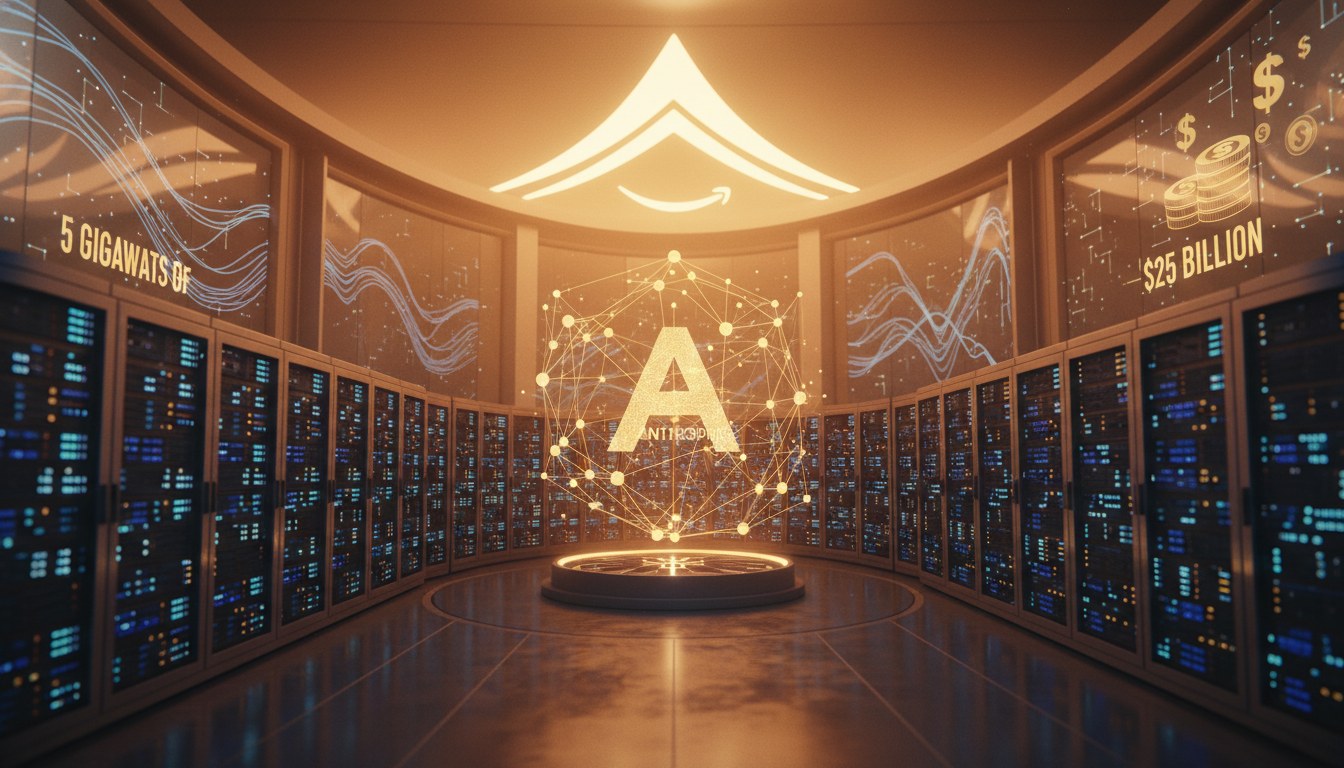
Anthropic has made its compute commitments unusually legible. The company has contracted with Amazon Web Services for over $100 billion across a decade, securing up to 5 gigawatts of compute capacity. A separate agreement with Google and Broadcom locks in 3.5 additional gigawatts of TPU capacity, expected to come online beginning in 2027. The SpaceX compute deal runs to $1.25 billion per month through May 2029. Before Anthropic's stock has traded a single share, the company has committed to spending at a scale that requires tens of thousands of server racks, millions of specialized chips, and the cables, switches, and retimers that connect them all.
That supply chain does not terminate at Amazon, Google, or SpaceX. It flows through a set of component suppliers whose revenues will scale with every rack Anthropic fills. The Motley Fool identified five of them in a June 7 analysis that cuts past the headline valuation story to the infrastructure economics underneath.
Key Facts
- Anthropic AWS compute commitment$100B+, up to 5 GW over a decade
- Google / Broadcom TPU deal3.5 GW, starting 2027
- SpaceX compute contract$1.25B/month through May 2029
- Marvell (MRVL) single-session surge+33% after Jensen Huang comment at Computex
- Five infrastructure plays identifiedMRVL, CLS, CRDO, ALAB, Coherent

The Five Stocks
Marvell Technology (MRVL) tops the list for the most direct connection. Marvell is one of the primary architects of custom silicon for hyperscalers, with 18 confirmed XPU chip sockets in its pipeline. When Amazon scales its Trainium processors to honor Anthropic commitments, Marvell's design wins convert to shipped silicon. The market picked up on this connection sharply at Computex on June 2, when Nvidia CEO Jensen Huang called Marvell a potential trillion-dollar company. MRVL shares surged 33% in a single session.
Celestica (CLS) sits one step further up the stack. The contract manufacturer integrates GPUs, custom silicon, and networking gear into finished, tested server racks that hyperscalers actually deploy. Celestica's DS6000-series 1.6 terabit Ethernet switches became available to order in April 2026, directly targeting the high-bandwidth fabrics that AI clusters require. Every gigawatt of compute capacity Anthropic activates means more racks that Celestica or its peers assemble.
Credo Technology (CRDO) supplies the Active Electrical Cables that connect GPUs inside AI clusters, a component whose demand scales with the number of interconnects in the system rather than the number of chips. Astera Labs (ALAB) designs the semiconductor connectivity silicon inside the rack itself: PCIe retimers, CXL memory controllers, and Ethernet fabric switches. In May 2026, Astera launched the Scorpio X-Series 320 Lane AI Fabric Switch, the largest open memory-semantic fabric switch on the market, aimed squarely at the cluster densities that frontier AI training requires. Coherent rounds out the five, with its data center and communications segment posting $1.36 billion in revenue for the most recent quarter as optical interconnect demand from AI infrastructure continues to grow.
"Anthropic has already committed to spending more than $100 billion with Amazon Web Services over the next decade, securing up to 5 gigawatts of compute capacity, with separate agreements with Google locking in another 5 gigawatts. That is 10 gigawatts of contracted AI compute demand from a single company before the IPO even happens." The Motley Fool, June 7, 2026
What Investors Should Keep in Mind
The infrastructure thesis is coherent, but it carries its own concentrations. Anthropic's contracted compute is not interchangeable: different providers use different chips, different interconnects, and different rack architectures, so a component supplier's exposure depends on which specific hyperscaler contracts are being filled. Marvell's XPU wins are tied to Amazon's Trainium roadmap; if Amazon changes its custom silicon strategy, Marvell's projected volumes change with it.
There is also a timing question. The Google and Broadcom TPU capacity does not come online until 2027, which means the revenue conversion for suppliers in that part of the chain is not imminent. SpaceX's Colossus cluster build is a different infrastructure topology from a traditional hyperscaler data center, and it is not yet clear which component suppliers benefit most from that specific buildout.
None of that makes the infrastructure angle wrong. Anthropic's Series H funding at a $965 billion valuation was accompanied by a commitment to deploy that capital at scale, and the physical infrastructure required to serve $47 billion in annualized revenue does not exist yet. The companies that build it will see that demand in their order books before it shows up in Anthropic's revenue line. For investors looking at the IPO wave and wondering where the infrastructure spending lands, the supply chain is a reasonable place to look.