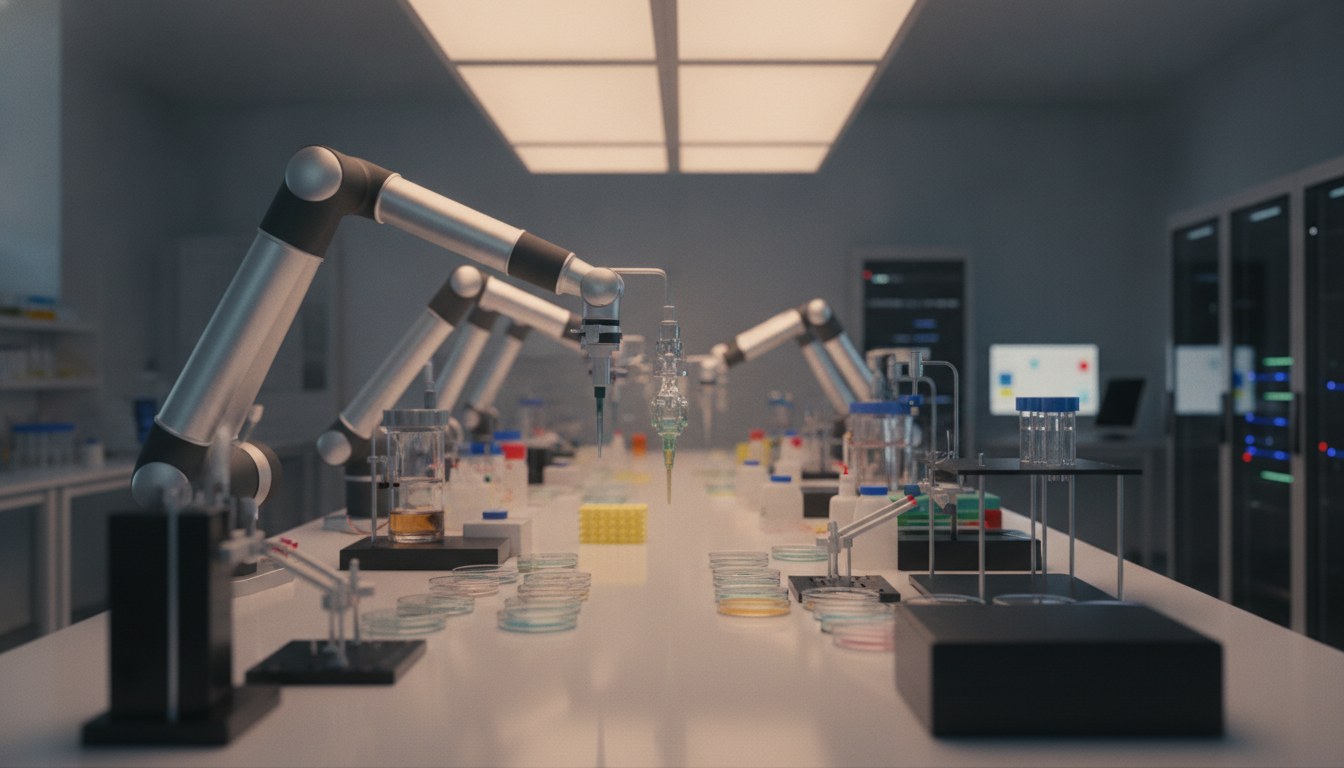
Anthropic is testing a new integration that would allow Claude to communicate directly with robots and scientific laboratory instruments, according to a Bloomberg report. The effort represents a shift in how the company sees its AI fitting into research workflows, moving past text and data tasks toward direct control of physical hardware in lab environments.
What the Integration Would Do
The system under development would let Claude issue commands to robotic arms, automated pipettes, spectrometers, and other common pieces of lab equipment. Scientists could, in theory, describe an experiment in plain language and have Claude translate that into a sequence of actions carried out by connected machines. This kind of natural-language-to-hardware pipeline has been a goal for lab automation companies for years, but progress has been slow due to the complexity of scientific protocols and the variety of equipment in use. Anthropic has previously launched tools aimed at scientific users, and this latest effort appears to extend that focus into physical lab settings.
Key Facts
- Anthropic is piloting Claude's ability to interface with robots and scientific instruments.
- The system aims to let researchers direct lab hardware using natural language.
- The effort builds on existing moves by Anthropic to position Claude as a research assistant.
- Bloomberg first reported the testing phase, with no confirmed launch date announced.
- The integration could affect fields like drug discovery, materials science, and biology.
The practical appeal for researchers is clear. Lab automation today typically requires custom scripts and specialist programmers. If Claude can sit between the scientist and the machine, interpreting intent and managing the sequencing of tasks, it could lower the barrier to running complex experiments. That said, accuracy in scientific contexts is non-negotiable, and any errors in command translation could compromise results or damage equipment. Anthropic has outlined a broader vision for Claude in scientific research, framing the AI as a capable collaborator rather than just a writing tool.
The ability to connect AI reasoning directly to physical lab systems could meaningfully accelerate experimental science, provided the reliability bar is met consistently.Bloomberg.com

Why This Matters for AI in Science
Connecting large language models to physical systems is an active area of research across the industry. The challenge is not just technical. It involves questions about oversight, error handling, and how much autonomy an AI should have when operating equipment that can cause real-world consequences. Anthropic has been deliberate about safety constraints across its model family, and those principles would presumably carry over into any robotics-facing deployment. The company has not detailed what guardrails would govern Claude's interaction with hardware, but that will likely be a central consideration as testing continues.
For the scientific community, the timing is notable. There is growing interest in AI-assisted research across biology, chemistry, and materials science. Automated labs already exist at some large pharmaceutical and technology companies, but access to such infrastructure is uneven. A software layer that lets Claude operate more generic lab hardware could extend automation capabilities to smaller research teams and academic institutions that lack dedicated robotics engineers. Anthropic's own data has shown how its AI is already reshaping knowledge work, and a move into physical science automation would mark a meaningful expansion of that footprint.
Anthropic has not announced a public release timeline for the feature. The testing phase suggests the company is still evaluating reliability and safety before any broader rollout. Researchers and lab equipment vendors will be watching closely to see whether Claude can meet the precision demands of real scientific work.


