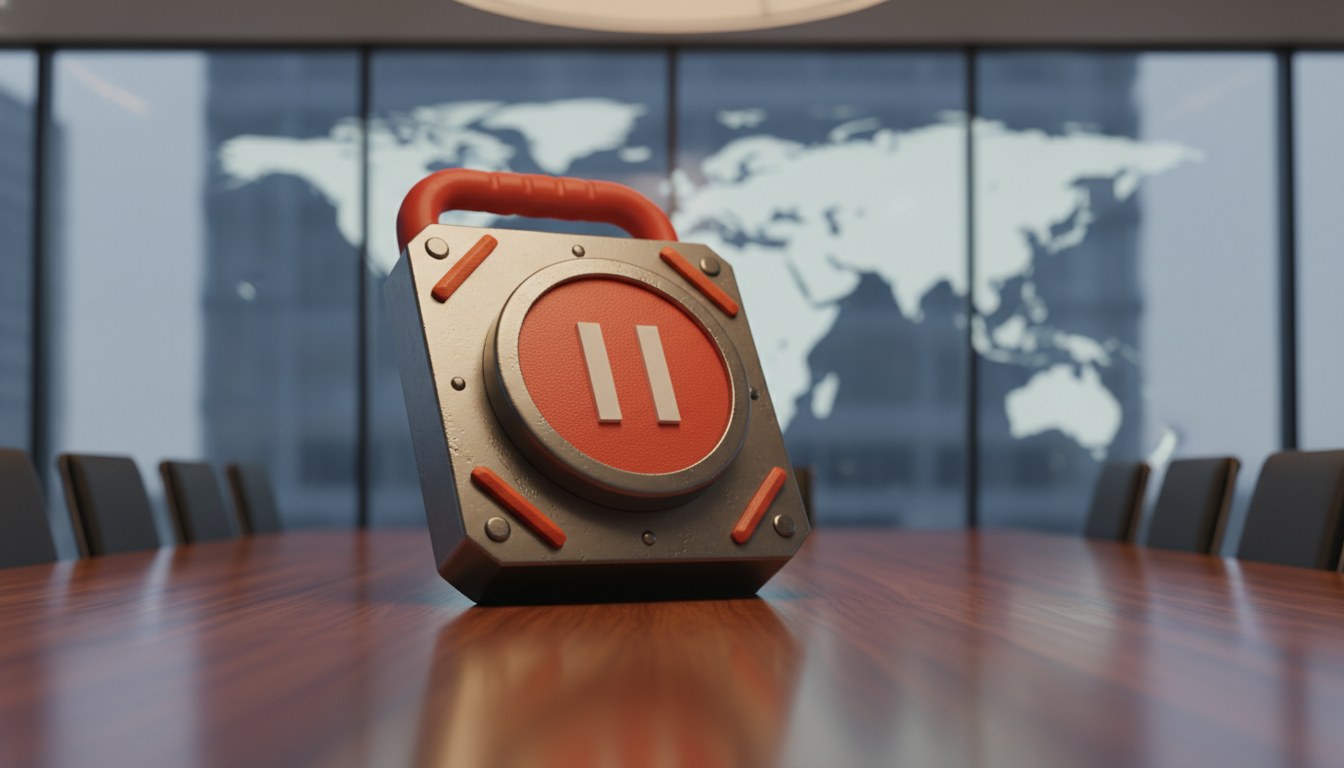
Anthropic has made a pointed public argument this week: the world should have the option to hit pause on artificial intelligence development if things start moving too fast. The company, which builds the Claude family of AI models, laid out this position in comments reported by The Guardian, framing a pause capability not as a retreat from progress but as a necessary safety mechanism. The timing is notable, coming alongside separate warnings from Anthropic that AI systems may soon begin improving themselves without meaningful human direction.
Why Anthropic Is Raising the Alarm Now
The company's position reflects a tension that has been building inside Anthropic for some time. On one hand, Anthropic is racing to ship competitive products and has revealed that Claude now writes roughly 80 percent of its own production code. On the other hand, its researchers are increasingly vocal about the risks that come with that pace. Scientific American reported this week that Anthropic has warned AI systems may soon reach a threshold where they begin recursive self-improvement, a process where a model iteratively rewrites and enhances its own architecture or training process with diminishing human oversight. Our earlier coverage of Anthropic's warnings on AI self-improvement and human control explored exactly this concern in depth.
Key Facts
- Anthropic publicly argued this week that nations should retain a mechanism to pause AI development.
- The company separately warned that recursive AI self-improvement may be imminent.
- Anthropic disclosed that Claude authors approximately 80% of the company's new production code.
- The statements come as Anthropic continues rapid product deployment across enterprise markets.
- No specific international framework for a pause mechanism has been proposed by the company yet.
The call for a pause option is a careful framing. Anthropic is not saying development should stop. It is saying the infrastructure to stop, if needed, should exist and should be agreed upon before an emergency makes the question urgent. That distinction matters for how policymakers and competitors are likely to receive the argument. Critics may still read it as a strategic move by an incumbent player to shape regulation in ways that favor established labs over newer entrants. Supporters will say it is simply honest risk management at civilizational scale.
"The world should have the option to pause on AI if things are moving too fast."Anthropic, via The Guardian
Self-Improvement Warnings and What They Mean in Practice
The recursive self-improvement warning is technically specific and worth taking seriously on its own terms. Current large language models do not rewrite their own weights during inference. But advances in automated machine learning, combined with systems that can write and execute code, are narrowing the gap between a model that assists engineers and a model that can meaningfully direct its own development. Anthropic's own disclosure that Claude now authors 80% of its production code illustrates how quickly that line is blurring in practice, even before any formal self-improvement architecture is in place.
For enterprise customers integrating AI into core workflows, these announcements carry practical weight beyond the philosophical. The same week Anthropic is calling for global pause mechanisms, it is also aggressively expanding its commercial footprint. VentureBeat reported on how enterprises can match Anthropic's internal code-generation practices, positioning Claude as a productivity multiplier rather than a risk vector. Those two stories, the safety warnings and the enterprise push, are not contradictory in Anthropic's view. The company has long argued that safety-focused labs must stay at the frontier to have any influence over where the frontier goes. Whether that argument holds as capabilities accelerate is a question the industry has not yet had to answer in a high-stakes scenario. Readers tracking how these dynamics are unfolding can follow the latest Claude AI news as it develops.
What is clear is that Anthropic has chosen a moment of peak commercial momentum to make its most direct public statements about systemic risk. That choice itself signals something about how seriously the company's leadership takes the near-term trajectory of the technology they are building.