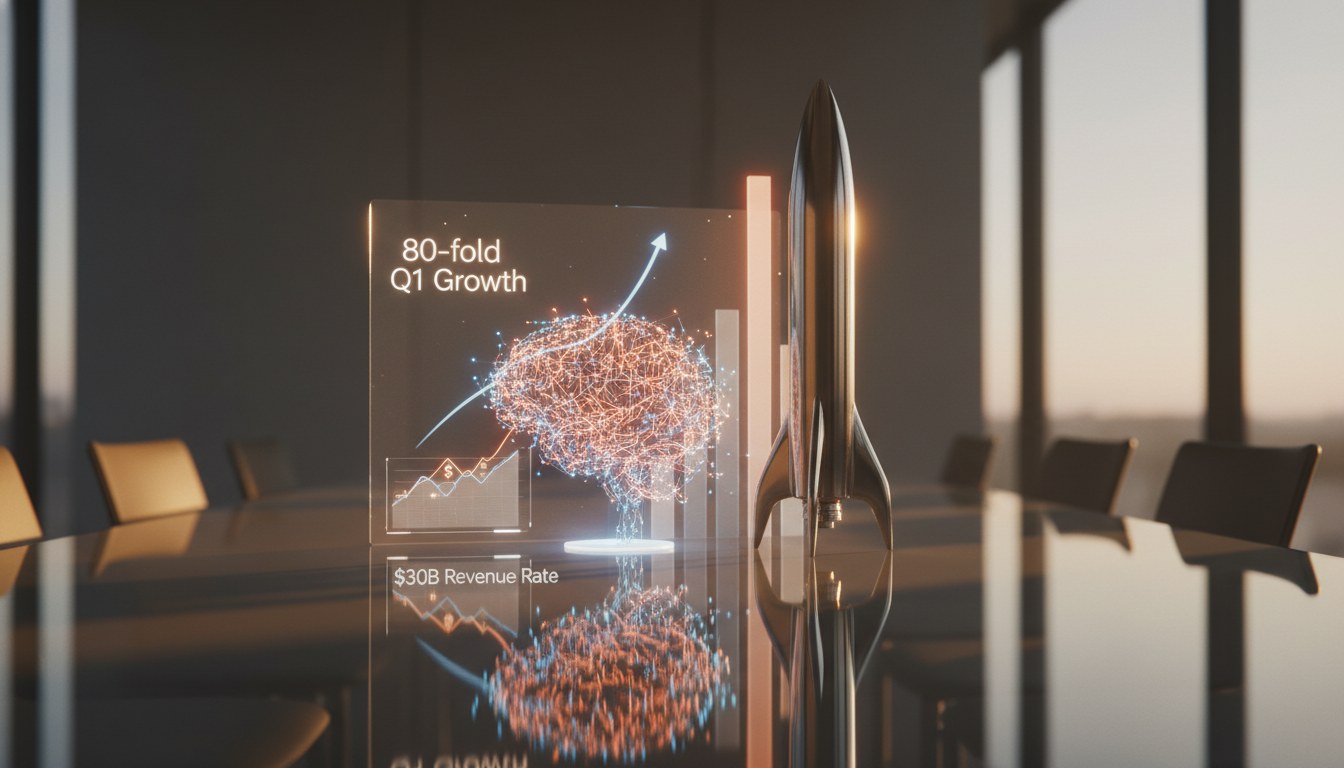
In early April 2026, two things happened at Anthropic on the same day. The company announced its revenue run rate had crossed $30 billion annually, up from $9 billion at the end of 2025. And Broadcom confirmed a deal to supply Anthropic with 3.5 gigawatts of tensor processing unit capacity, built on Google's TPU architecture, with deployment beginning in 2027. The revenue figure and the compute deal were not coincidental. One explained why the other was necessary.
Revenue at $30 Billion
Anthropic's revenue trajectory over the past 14 months sits outside the normal frame of reference for software company growth. The company entered 2024 generating roughly $87 million on an annualized basis. By the end of 2025, that figure was $9 billion. By early April 2026, it had crossed $30 billion, a more than threefold jump in under three months.
The growth is concentrated in a small number of products. Claude Code, the company's agentic software development tool, launched publicly in mid-2025 and hit $1 billion in annualized revenue within six months. That pace has continued. Claude Code is now described internally as the fastest-growing product in Anthropic's history and, by several external measures, one of the fastest-growing software products on record. API revenue from Anthropic's broader 80-fold first-quarter growth is compounding alongside it, with more than 1,000 enterprises now spending over $1 million per year with the company, up from 500 when the company closed its Series G in February.
Key Facts
- Revenue run rate (April 2026)$30 billion
- Revenue run rate (December 2025)$9 billion
- New Broadcom TPU compute3.5 gigawatts
- Compute deployment start2027
- Enterprise customers ($1M+/yr)1,000+
- Claude Code ARR (within 6 months)$1 billion

The Broadcom Deal
The compute side of the April 6 announcement centers on Broadcom. The chip company has agreed to supply Anthropic with 3.5 gigawatts of TPU-based capacity, built around Google's tensor processing units and structured to give Anthropic dedicated access rather than shared cloud allocation. Broadcom's involvement reflects the increasingly layered supply chain of frontier AI compute: Google designs the chips, Broadcom handles integration and manufacturing of key components, and Anthropic operates the workloads running on top.
The 3.5-gigawatt figure represents new infrastructure, not reserved existing capacity. It sits alongside the 5 gigawatts Google committed under a separate direct investment partnership announced on April 24, giving Anthropic a combined pipeline of more than 8 gigawatts of compute coming online over the next two years. For reference, Anthropic's current production infrastructure is estimated to require between 500 megawatts and 1 gigawatt to serve its existing traffic load. The new capacity is sized for a company operating at several times today's scale.
"Our run-rate revenue has surpassed $30 billion, up from $9 billion at the end of 2025, as demand for Claude continues to accelerate. This partnership gives us the compute to keep pace." Anthropic, statement on the Broadcom and Google compute deals, April 2026
Enterprise Momentum Driving the Numbers
The $30 billion run rate is not a product of a single large contract or a few outsized deals. It reflects a broad shift in how enterprises are procuring AI. In February 2026, when Anthropic closed its Series G financing, more than 500 customers were each spending over $1 million per year. By early April, that count had passed 1,000, a doubling in less than two months.
The businesses spending at that level span industries: pharmaceuticals, financial services, legal services, and software development all appear prominently. Bristol Myers Squibb deployed Claude across its drug discovery and research workflows. Goldman Sachs built agentic trading research tools on the Claude platform. Law firms using Claude's legal MCP connector ecosystem represent a growing share of the company's revenue, with adoption accelerating across large practices in the United States and Europe.
What Comes Next
Anthropic has provided limited forward guidance but has indicated that its revenue trajectory is not expected to flatten in the near term. The company's model roadmap includes at least two major releases in the second half of 2026, and enterprise partnership announcements have continued at a pace that has exceeded both internal and analyst expectations.
The compute secured in the Broadcom and Google investment deals gives Anthropic the infrastructure to serve demand at a scale that its existing capacity could not support. Whether revenue growth continues near its current rate depends on whether demand for AI-assisted software development and enterprise automation reaches a saturation point that, as of mid-2026, shows no clear signs of approaching. Anthropic's own planning models anticipated 10-fold growth in 2026. Actual first-quarter performance came in at 80-fold. The gap between those two numbers is as accurate a measure of the moment as any.